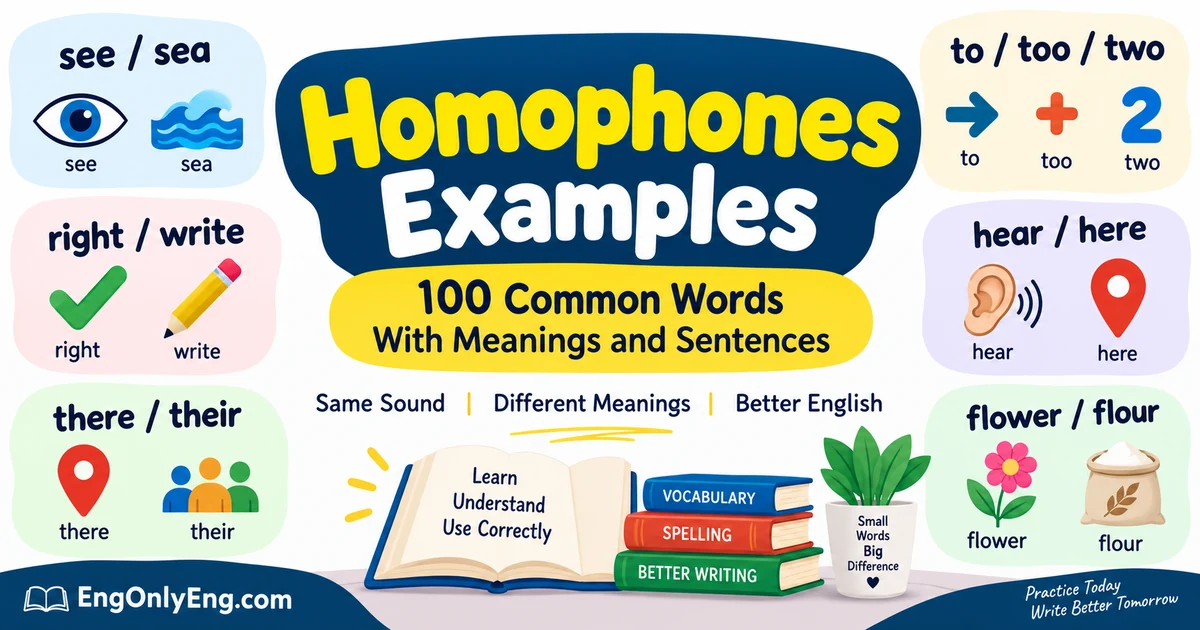
Homophones Examples: 100 Common Words With Meanings and Sentences
Have you ever written “their” when you meant “there”, or confused “right” with “write”?
These words are called homophones.
Homophones are words that have the same or very similar pronunciation but different meanings and usually different spellings. For example, “sea” and “see” sound the same, but they have completely different meanings.
Learning common homophones examples can improve your spelling, vocabulary, writing and exam performance. They are especially useful for students and English learners because many homophones are used in everyday English.
You can also explore more useful word lessons in our Vocabulary section.
What Are Homophones?
A homophone is a word that sounds the same as another word but has a different meaning or spelling.
For example:
See = to look at something
Sea = a large body of salt water
Example:
I can see the sea from my hotel room.
Both words sound alike, but their meanings and spellings are different.
Another common example is:
Right = correct, or the opposite of left
Write = to form words using a pen, pencil or keyboard
Example:
Please write the right answer.
Homophones can be confusing because pronunciation alone may not tell you which spelling is correct. You have to understand the meaning of the sentence.
100 Homophones Examples With Meanings
Here are 50 common homophone pairs, giving you 100 useful words to learn.
| Homophones | Meaning |
|---|---|
| accept / except | receive / excluding |
| aloud / allowed | spoken loudly / permitted |
| ate / eight | past of eat / number 8 |
| be / bee | exist / flying insect |
| blue / blew | a colour / past of blow |
| brake / break | stop a vehicle / damage or separate |
| buy / by | purchase / near or through |
| cell / sell | small room or basic unit / give for money |
| cent / scent | money unit / smell |
| dear / deer | loved or expensive / animal |
| die / dye | stop living / change colour |
| fair / fare | reasonable / travel charge |
| flour / flower | baking powder / plant blossom |
| for / four | intended for / number 4 |
| hair / hare | strands on the head / rabbit-like animal |
| heal / heel | become healthy / back of the foot |
| hear / here | receive sound / this place |
| hole / whole | opening / complete |
| hour / our | 60 minutes / belonging to us |
| knight / night | old warrior / time after evening |
| know / no | understand / negative answer |
| mail / male | letters and parcels / masculine |
| meat / meet | animal flesh used as food / come together |
| one / won | number 1 / past of win |
| pair / pear | set of two / fruit |
| peace / piece | absence of conflict / part of something |
| plain / plane | simple or flat land / aircraft |
| principal / principle | head of a school / rule or belief |
| rain / reign | water from clouds / period of ruling |
| right / write | correct / form words |
| road / rode | street / past of ride |
| role / roll | function or part / move by turning |
| sail / sale | travel by boat / selling at reduced prices |
| scene / seen | part of an event / past participle of see |
| sea / see | large body of water / look at |
| son / sun | male child / star in the sky |
| stair / stare | step / look continuously |
| stationary / stationery | not moving / writing materials |
| steal / steel | take illegally / strong metal |
| tail / tale | animal’s rear part / story |
| their / there | belonging to them / place |
| threw / through | past of throw / from one side to another |
| to / too | towards / also or excessively |
| two / too | number 2 / also |
| waist / waste | middle of the body / use carelessly |
| wait / weight | stay until something happens / heaviness |
| weak / week | not strong / seven days |
| wear / where | have clothes on / asking about place |
| weather / whether | atmospheric conditions / expressing alternatives |
| which / witch | asking about choice / magical character in stories |
Common Homophones Examples in Sentences
Understanding homophones becomes easier when you see both words in meaningful sentences.
There, Their and They’re
There refers to a place.
Their shows possession.
They’re is the short form of “they are”.
Examples:
The books are over there.
Their teacher is very helpful.
They’re preparing for the English test.
To, Too and Two
To is commonly used before a destination or verb.
Too can mean “also” or “more than needed”.
Two is the number 2.
Examples:
I am going to school.
Ravi wants to come too.
I bought two notebooks.
Your and You’re
Your shows possession.
You’re means “you are”.
Examples:
Where is your English book?
You’re improving your vocabulary.
Hear and Here
Hear means to receive sound.
Here means in this place.
Example:
Come here so that you can hear me clearly.
Right and Write
Right can mean correct.
Write means to put words on paper or a screen.
Example:
Write the right answer in your notebook.
Principal and Principle
Principal can refer to the head of a school.
Principle means an important rule, belief or idea.
Examples:
Our school principal addressed the students.
Honesty is an important principle.
These two words are especially important for students because they are often confused in writing.
Homophones vs Homonyms vs Homographs
These three terms can look confusing, but they describe different relationships between words.
Homophones sound alike but usually have different spellings and meanings.
Example:
right / write
Homographs have the same spelling but different meanings, and sometimes different pronunciations.
Example:
lead, meaning to guide
lead, meaning a metal
Homonym is a broader term that is sometimes used for words that share pronunciation or spelling but have different meanings.
For beginners, the easiest rule is:
Homophone = same sound
Homograph = same spelling
Why Are Homophones Important?
Homophones matter because using the wrong word can completely change your sentence.
Compare:
I want to buy a book.
I want to by a book.
The first sentence is correct. The second is incorrect because “by” has a different meaning.
Homophones are particularly important in writing because listeners can often understand the intended meaning during conversation, but written English requires the correct spelling.
They can help you improve:
Spelling
Vocabulary
Reading comprehension
Sentence writing
School examinations
Competitive examinations
Professional communication
Common Homophone Mistakes to Avoid
One common mistake is choosing a word only by its sound.
Incorrect:
I can here you.
Correct:
I can hear you.
Another mistake is confusing contractions.
Incorrect:
Their going to school.
Correct:
They’re going to school.
Another common problem is using “your” instead of “you’re”.
Incorrect:
Your very helpful.
Correct:
You’re very helpful.
Always ask yourself what the word means in the sentence before choosing its spelling.
Easy Trick to Learn Homophones
Do not try to memorise hundreds of homophones in one sitting.
Learn them in pairs and create one sentence that contains both words.
For example:
Flower / Flour
The flower was beside the bag of flour.
Sea / See
I can see the sea.
Knight / Night
The knight travelled at night.
Peace / Piece
He ate a piece of cake in peace.
This method connects the pronunciation, spelling and meaning in your memory.
You can also study our lesson on Silent Letters Words in English to improve your spelling and pronunciation further.
Homophones Practice Exercise
Choose the correct word.
- I can (hear / here) someone calling me.
- She bought a (pair / pear) of shoes.
- Please (write / right) your name.
- The (sun / son) is shining brightly.
- We waited for an (hour / our).
- The students forgot (their / there) books.
- I would like (to / too) learn English.
- The car’s (brake / break) is not working properly.
- Our school (principal / principle) spoke at the assembly.
- I want to (buy / by) a new dictionary.
Answers
- hear
- pair
- write
- sun
- hour
- their
- to
- brake
- principal
- buy
Frequently Asked Questions
What are homophones?
Homophones are words that sound the same but have different meanings or spellings.
What are five examples of homophones?
Five common examples are sea and see, right and write, hear and here, son and sun, and flour and flower.
Are “to”, “too” and “two” homophones?
Yes. They are pronounced alike in normal speech but have different spellings and meanings.
Are “there”, “their” and “they’re” homophones?
Yes. They usually sound the same but perform different jobs in a sentence.
What is the difference between a homophone and a homograph?
Homophones share the same pronunciation. Homographs share the same spelling.
How can students learn homophones easily?
Learn them in pairs, understand their meanings and use both words in one memorable sentence.
Why do homophones cause spelling mistakes?
They sound alike, so learners may choose the spelling they remember first instead of checking which meaning fits the sentence.
Conclusion
Homophones may sound identical, but their meanings and spellings can be very different.
Words such as “see” and “sea”, “right” and “write”, and “hear” and “here” show why context is important in English.
Instead of memorising a huge list, learn a few pairs every day. Read their meanings, write your own sentences and practise choosing the correct word.
This simple habit can improve your vocabulary, spelling and confidence in written English.
For more simple English grammar and vocabulary lessons, visit Eng Only Eng.
For a dictionary-based explanation of homophones, you can also consult Merriam-Webster’s homophone entry. Merriam-Webster: Homophone definition