Prefix and Suffix Examples: 100+ Words With Meanings and Easy Rules
Have you ever seen a long English word and wondered what it means?
Sometimes, you do not need to learn the whole word separately. You can understand it by looking at its smaller parts.
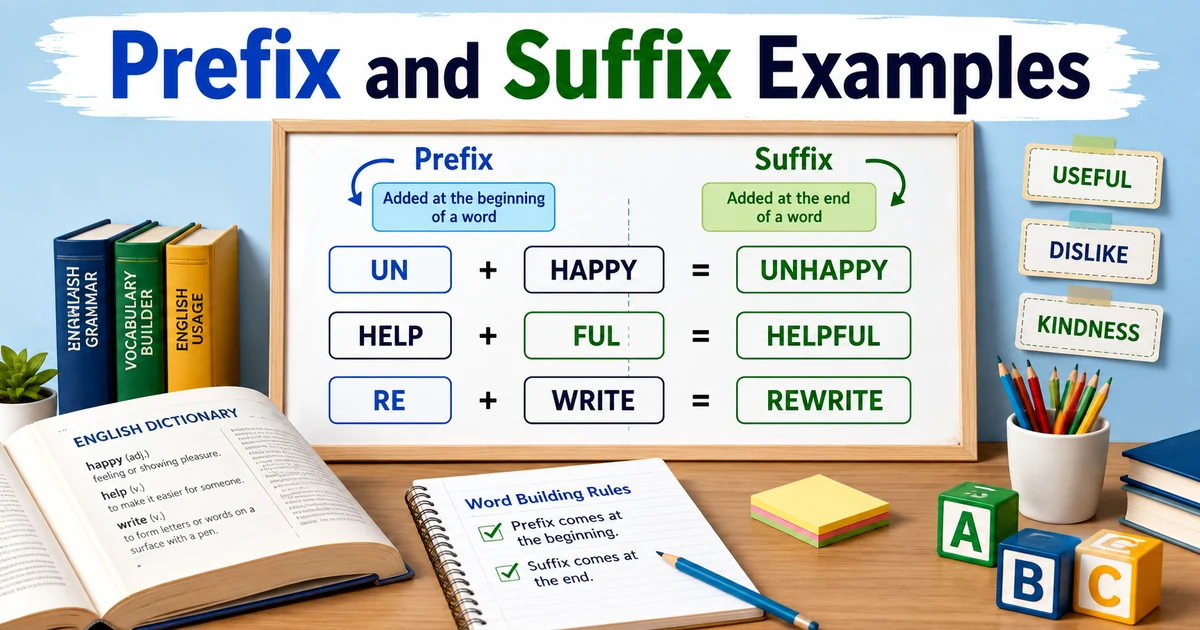
A prefix is a group of letters added to the beginning of a word. A suffix is a group of letters added to the end of a word. Both can change the meaning or form of the original word.
For example:
un + happy = unhappy
help + ful = helpful
In “unhappy”, un is the prefix.
In “helpful”, ful is the suffix.
Learning common prefix and suffix examples can help you understand unfamiliar words, improve your spelling and build a stronger English vocabulary.
If you are working on your vocabulary, you can also explore our Vocabulary lessons.
What Is a Prefix?
A prefix is a letter or group of letters added before a base word.
It usually changes the meaning of the word.
For example:
happy = feeling pleased
un + happy = unhappy
The prefix “un” means “not”. Therefore, unhappy means “not happy”.
Another example is:
re + write = rewrite
The prefix “re” means “again”. Rewrite means to write something again.
What Is a Suffix?
A suffix is a letter or group of letters added to the end of a word.
A suffix can change the meaning of a word. It can also change its word class.
For example:
care + ful = careful
The suffix “ful” means “full of” or “having”.
Another example is:
happy + ness = happiness
Here, the adjective “happy” becomes the noun “happiness”.
Prefix vs Suffix: What Is the Difference?
| Feature | Prefix | Suffix |
|---|---|---|
| Position | Beginning of a word | End of a word |
| Main purpose | Usually changes meaning | Can change meaning or word class |
| Example | un + happy | help + ful |
| New word | unhappy | helpful |
| Another example | re + write | kind + ness |
| New word | rewrite | kindness |
An easy way to remember the difference is:
Prefix comes before the main word.
Suffix comes after the main word.
Common Prefix and Suffix Examples
Let us first look at some common prefixes.
Common Prefixes With Meanings and Examples
| Prefix | Meaning | Examples |
|---|---|---|
| un | not, opposite | unhappy, unfair, unsafe |
| re | again | rewrite, reread, reopen |
| dis | not, opposite | disagree, dishonest, disconnect |
| mis | wrongly, badly | misunderstand, misbehave, mispronounce |
| pre | before | prepay, preview, preschool |
| post | after | postgraduate, postdate, postscript |
| non | not | nonfiction, nonstop, nonverbal |
| over | too much, above | overcook, overwork, overconfident |
| under | below, too little | underground, underpay, underestimate |
| inter | between, among | international, interact, interschool |
| sub | under, below | subtitle, subheading, submarine |
| co | together | coauthor, coworker, cooperate |
| auto | self | autobiography, automatic, autopilot |
| bi | two | bicycle, bilingual, bilateral |
| multi | many | multilingual, multimedia, multinational |
These prefixes can help you understand many new words.
For example, if you know that “multi” means “many”, you can understand that “multilingual” relates to many languages.
Common Suffixes With Meanings and Examples
| Suffix | Meaning or Function | Examples |
|---|---|---|
| ful | full of, having | helpful, careful, useful |
| less | without | careless, hopeless, fearless |
| ness | state or quality | kindness, happiness, darkness |
| ment | action, result or state | development, movement, improvement |
| er | person who does something | teacher, reader, worker |
| tion | action, process or state | education, creation, information |
| sion | action or state | decision, revision, expansion |
| ly | in a particular manner | quickly, slowly, carefully |
| able | capable of being | readable, washable, comfortable |
| ible | capable of being | possible, visible, flexible |
| ist | person connected with something | artist, scientist, pianist |
| ship | state or relationship | friendship, leadership, membership |
| hood | state or period | childhood, neighbourhood, brotherhood |
| ous | having a quality | famous, curious, dangerous |
| al | relating to | national, personal, natural |
You do not have to memorise every suffix at once. Start with the common ones such as “ful”, “less”, “ness”, “ment” and “ly”.
Words With Both a Prefix and a Suffix
A word can have both a prefix and a suffix.
Look at this example:
un + help + ful = unhelpful
“Un” is the prefix.
“Help” is the base word.
“Ful” is the suffix.
Here are more examples:
| Prefix | Base Word | Suffix | Complete Word |
|---|---|---|---|
| un | help | ful | unhelpful |
| un | happy | ness | unhappiness |
| dis | agree | ment | disagreement |
| re | arrange | ment | rearrangement |
| un | comfort | able | uncomfortable |
| im | possible | ity | impossibility |
| un | kind | ness | unkindness |
| mis | understand | ing | misunderstanding |
| dis | respect | ful | disrespectful |
| un | success | ful | unsuccessful |
Breaking long words into smaller parts makes them easier to understand.
Important Prefix Spelling Rules
Prefixes are usually simple because the spelling of the base word often stays the same.
For example:
un + kind = unkind
re + write = rewrite
mis + understand = misunderstand
However, some negative prefixes change their form depending on the first letter of the word.
In, Im, Il and Ir
All of these can carry the idea of “not”, but they are used with different words.
Examples:
in + correct = incorrect
im + possible = impossible
il + legal = illegal
ir + regular = irregular
Do not create a word by choosing a prefix only because its meaning seems correct.
For example:
“unpossible” is incorrect.
“impossible” is correct.
Important Suffix Spelling Rules
Suffixes sometimes change the spelling of the base word.
Rule 1: Change Y to I
When some words end in a consonant followed by “y”, the “y” often changes to “i” before certain suffixes.
happy + ness = happiness
easy + ly = easily
lazy + ness = laziness
Do not write “happyness”.
Write “happiness”.
Rule 2: Final E May Be Removed
A final silent “e” is often removed before a suffix that begins with a vowel.
make + ing = making
use + able = usable
hope + ing = hoping
This spelling rule is connected with other English spelling patterns. You may also find our lesson on silent letters words in English useful.
Rule 3: Sometimes the Final Consonant Doubles
Some short words double their final consonant before certain suffixes.
run + ing = running
big + er = bigger
hot + est = hottest
Learning the word together with its new form is one of the easiest ways to remember these changes.
Common Mistakes Indian Learners Should Avoid
Mistake 1: Using the Wrong Negative Prefix
Incorrect: unpossible
Correct: impossible
Incorrect: inregular
Correct: irregular
Learn common prefix and word combinations together instead of translating them directly from another language.
Mistake 2: Forgetting the Spelling Change
Incorrect: happyness
Correct: happiness
The “y” changes to “i” before “ness”.
Mistake 3: Thinking Every Prefix Makes a Negative Word
Not every prefix means “not”.
For example:
rewrite = write again
preview = view before
underground = below the ground
international = between or involving nations
Always learn the meaning of the prefix.
Mistake 4: Thinking Every Suffix Has the Same Job
Different suffixes perform different jobs.
For example:
kind = adjective
kindness = noun
quick = adjective
quickly = adverb
teach = verb
teacher = noun
The suffix can change the type of word.
Mistake 5: Memorising Words Without Understanding the Parts
Do not simply memorise “disagreement”.
Break it into:
dis + agree + ment
This makes the word much easier to remember.
Easy Trick to Learn Prefixes and Suffixes
Choose one base word and see how many new words you can create.
Take the word “help”.
help
helpful
helpless
unhelpful
helper
helpfulness
One simple word can teach you several useful patterns.
You can also make your own vocabulary notebook.
Write four columns:
Prefix or Suffix
Meaning
Example Word
Your Own Sentence
For additional practice with prefixes and suffixes, the British Council LearnEnglish resource provides a simple learner exercise.
Quick Practice Exercise
Complete the following words with the correct prefix or suffix.
- ___possible, meaning not possible
- ___write, meaning write again
- ___regular, meaning not regular
- kind + ___, meaning the quality of being kind
- care + ___, meaning full of care
- hope + ___, meaning without hope
- quick + ___, forming an adverb
- friend + ___, describing a relationship between friends
- read + ___, meaning capable of being read
- dis + agree + ___, forming a noun
Answers
- impossible
- rewrite
- irregular
- kindness
- careful
- hopeless
- quickly
- friendship
- readable
- disagreement
Frequently Asked Questions
What is a prefix with an example?
A prefix is a group of letters added to the beginning of a word. For example, “un” is added to “happy” to form “unhappy”.
What is a suffix with an example?
A suffix is added to the end of a word. For example, “ful” is added to “help” to form “helpful”.
What are five common prefixes?
Five common prefixes are un, re, dis, mis and pre.
Examples include unhappy, rewrite, disagree, misunderstand and preview.
What are five common suffixes?
Five common suffixes are ful, less, ness, ment and ly.
Examples include helpful, careless, kindness, development and quickly.
Can a word have both a prefix and a suffix?
Yes. For example, “unhelpful” contains the prefix “un”, the base word “help” and the suffix “ful”.
Do prefixes change the spelling of the base word?
Usually, the base spelling remains unchanged. However, some prefixes have different forms, such as in, im, il and ir.
Why should students learn prefixes and suffixes?
They make it easier to understand new words, recognise word families, improve spelling and build vocabulary.
Conclusion
Prefixes and suffixes are small word parts, but they can help you understand hundreds of English words.
Remember the basic rule:
A prefix comes before a word.
A suffix comes after a word.
Start with common prefixes such as un, re, dis, mis and pre. Then learn useful suffixes such as ful, less, ness, ment and ly.
Do not try to memorise everything in one day. Learn a few examples, use them in your own sentences and revise them regularly.
For more simple English lessons, vocabulary guides and learning resources for students, visit Eng Only Eng.