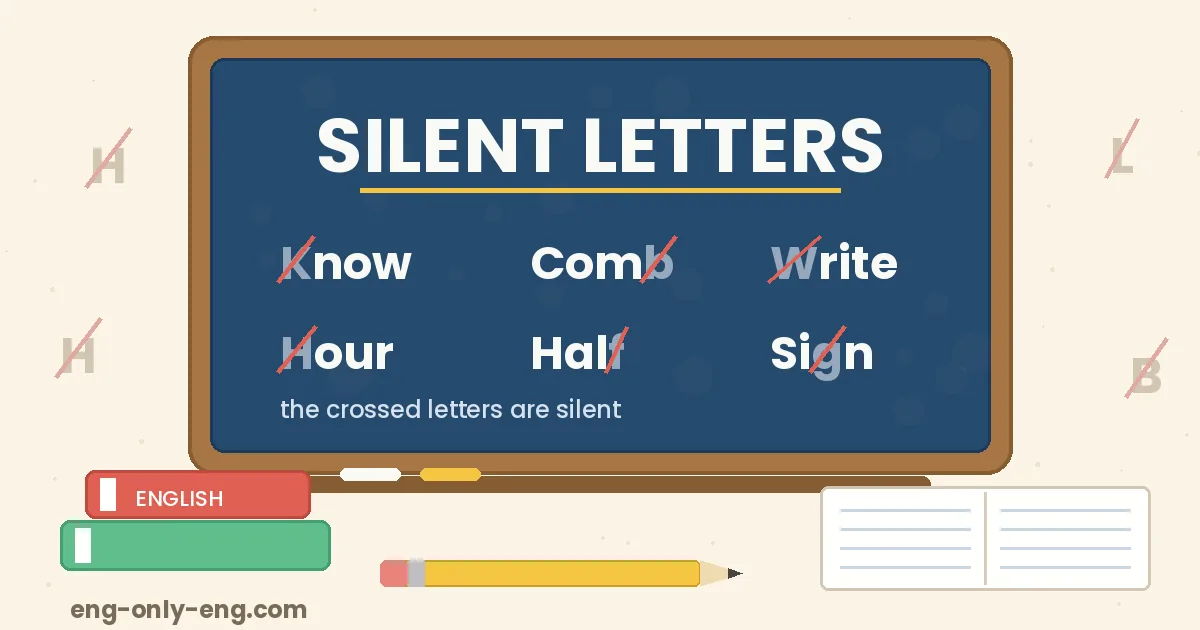
Silent Letters Words in English: Full A to Z List with Easy Rules
Have you ever wondered why “knife” is not pronounced as “ker-nife”, or why the “b” in “comb” stays completely quiet? Welcome to the tricky world of silent letters. These are letters that we write but do not speak, and they confuse learners all over India. The word “Wednesday” alone has caught out thousands of students.
The good news is that silent letters are not random. They follow clear patterns. Once you learn these patterns, your spelling and pronunciation will both improve. In this lesson, you will learn what silent letters are, a full A to Z list of silent letters words in English, simple rules for each group, common mistakes, and a short practice exercise.
What Are Silent Letters?
A silent letter is a letter that is written in a word but not pronounced when we say the word. For example, in the word “hour”, the letter “h” is silent, so we say “our”. Silent letters exist because English borrowed words from many languages like French, Latin, and Greek, and the spelling stayed the same even when the pronunciation changed over time.
Almost every letter of the alphabet can be silent in some word. Learning the common groups is the fastest way to master them.
Why Do Silent Letters Matter for Learners?
Silent letters matter for three simple reasons. First, they improve your spelling, because you learn to write letters you cannot hear. Second, they improve your pronunciation, so you do not say “k-now” instead of “now”. Third, they help in exams and interviews, where correct spelling and clear speech create a strong impression. For learners who want smoother speech overall, our lesson on daily use sentences in English is a helpful next step.
Silent Letters Words in English: A to Z List
Here is a group-by-group list. Read each word aloud and notice which letter stays quiet.
| Silent Letter | Rule or Pattern | Example Words |
| Silent B | B is silent after M, and before T | comb, thumb, lamb, climb, debt, doubt |
| Silent C | C is often silent after S | scissors, science, muscle, scene, scent |
| Silent D | D is silent in some common words | Wednesday, handkerchief, sandwich, edge |
| Silent E | E is silent at the end of many words | name, make, time, hope, cake, love |
| Silent G | G is silent before N | sign, design, foreign, gnome, champagne |
| Silent H | H is silent after W, and in some words | hour, honest, honour, ghost, rhyme, what |
| Silent K | K is silent before N at the start | know, knife, knee, knock, knowledge, knot |
| Silent L | L is silent before F, M, K, D | half, calm, talk, walk, could, should |
| Silent N | N is silent after M at the end | autumn, column, hymn, condemn, solemn |
| Silent P | P is silent before S, N, T | psychology, pneumonia, receipt, cupboard |
| Silent S | S is silent in a few words | island, aisle, isle |
| Silent T | T is silent after S, and in some words | listen, castle, whistle, often, fasten |
| Silent U | U is silent after G | guess, guitar, guard, guide, tongue |
| Silent W | W is silent before R, and in some words | write, wrong, wrist, answer, two, sword |
This covers the most useful silent letters words in English for everyday use, exams, and speaking.
Simple Rules to Remember Silent Letters
You do not need to memorise every word. Learn these five easy rules and you will handle most silent letters.
Rule 1: Silent K and G before N. When a word starts with “kn” or “gn”, the first letter is silent. Say “know” as “no” and “gnome” as “nome”.
Rule 2: Silent B after M and before T. The “b” goes quiet in “comb”, “thumb”, “climb”, “debt”, and “doubt”.
Rule 3: Silent W before R. When “w” comes before “r”, it is silent. Say “write” as “rite” and “wrong” as “rong”.
Rule 4: Silent L before certain consonants. The “l” is often silent in “half”, “calm”, “talk”, “walk”, “would”, and “should”.
Rule 5: Silent E at the end. A final “e” is usually silent, but it often changes the vowel sound before it. Compare “hop” and “hope”, or “cut” and “cute”.
If you are ever unsure how a word is really pronounced, you can check its audio in a trusted source like the Cambridge English Dictionary pronunciation guide, which lets you hear the correct sound and spot the silent letters yourself.
Common Mistakes Indian Learners Make
Mistake 1: Pronouncing the silent K. Learners often say “k-nife” or “k-nee”. Remember, the K in “kn” words is always silent.
Mistake 2: Adding the L sound. Words like “salmon” and “palm” have a silent L. Say “sam-on” and “pam”, not “sal-mon”.
Mistake 3: Speaking the B in “debt” and “doubt”. These two words trap many students. The B is completely silent, so say “det” and “dout”.
Mistake 4: Missing the silent letter in spelling. Because the letter is silent, learners forget to write it. This is why “Wednesday” and “government” are often misspelt. Practise writing them a few times.
Mistake 5: The word “often”. Both pronunciations exist, but the more traditional and exam-safe way keeps the T silent, so it sounds like “off-en”.
Quick Practice Exercise
Find the silent letter in each word. Try first, then check the answers below.
1. Knock
2. Honest
3. Column
4. Castle
5. Guitar
6. Wrong
Answers: 1. Silent K 2. Silent H 3. Silent N 4. Silent T 5. Silent U 6. Silent W
Practice tip: pick five words with silent letters from the table above and say each one aloud ten times. Then write them in short sentences. This trains both your speaking and your spelling at the same time. For more free lessons, explore our Grammar section, where new topics are added regularly.
Frequently Asked Questions
What are silent letters in English?
Silent letters are letters that are written in a word but not pronounced. For example, the “k” in “knife” and the “b” in “comb” are silent. English has many of them because it borrowed words from other languages.
What are the most common silent letters?
The most common silent letters are silent K (know, knee), silent B (comb, thumb), silent W (write, wrong), silent L (talk, calm), silent H (hour, honest), and silent E at the end of words (name, hope).
Why does English have silent letters?
English took many words from French, Latin, and Greek. Over time, the pronunciation changed but the old spelling stayed. That is why we still write letters we no longer speak.
Is the letter T silent in “often”?
Traditionally, the T in “often” is silent, so it sounds like “off-en”. Some speakers do pronounce the T today, but keeping it silent is the safer choice in exams and formal speech.
How can I learn silent letters easily?
Learn them in groups instead of one by one. Study the common patterns, such as silent K before N or silent W before R, then read the words aloud and use them in sentences daily.
Conclusion
Silent letters look confusing at first, but they follow clear patterns. Remember the key groups: silent K and G before N, silent B after M, silent W before R, silent L before certain consonants, and silent E at the end of words. Use the A to Z list above as your quick reference, practise the words aloud, and write them often to fix the spelling in your memory. With a little daily practice, silent letters will stop being a problem and start being easy. For more free English lessons, tools, and courses, keep visiting Eng Only Eng and keep improving every day.