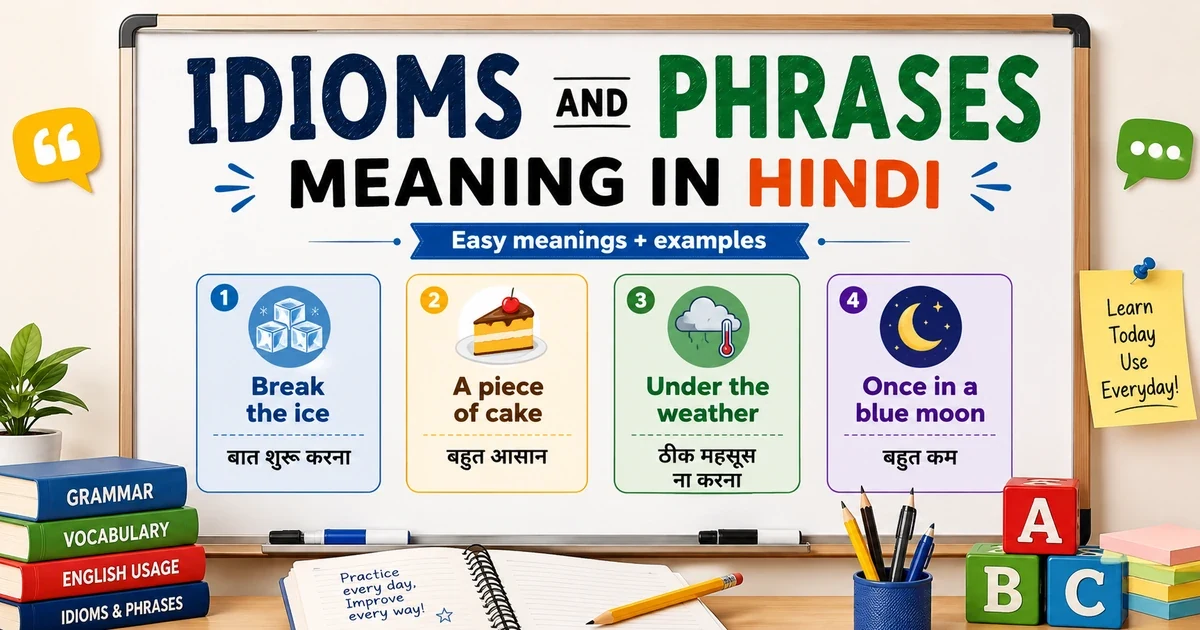
Idioms and Phrases Meaning in Hindi: 25 Easy Examples
Idioms and phrases are useful when you want to understand natural English, speak more confidently, or prepare for school and competitive exams. But they are not the same thing. An idiom has a special meaning that is often different from the literal meanings of its individual words. A phrase is simply a small group of words used together as part of a sentence.
In simple Hindi, idiom means “मुहावरा” and phrase means “वाक्यांश” or a useful group of words. This lesson explains the difference and gives 25 common idioms and phrases with Hindi meanings and easy English sentences.
For more word and expression lessons, explore our Vocabulary section.
What Is an Idiom?
An idiom is a fixed expression whose real meaning cannot always be understood by translating each word separately. Cambridge Dictionary describes an idiom as a group of words used in a fixed order with a particular meaning that differs from the meanings of the individual words.
Example: “A piece of cake” does not usually mean a slice of cake. As an idiom, it means something that is very easy. Hindi meaning: बहुत आसान काम।
You can also check the learner definition of an idiom in the Cambridge Dictionary.
What Is a Phrase?
A phrase is a short group of words that works together inside a sentence. Its meaning may be literal, so not every phrase is an idiom.
Examples include “in the morning”, “at the moment”, “on time” and “by the way”. These groups of words are useful in everyday speech, but they do not all have hidden or figurative meanings.
Idiom vs Phrase: Easy Difference
| Point | Idiom | Phrase |
| Meaning | Often figurative or special | Usually direct or grammatical |
| Word by word translation | Often gives the wrong meaning | May still make sense |
| Example | A piece of cake | In the morning |
| Hindi idea | मुहावरा | वाक्यांश |
A useful rule is this: every idiom is a type of expression or phrase, but every phrase is not an idiom.
17 Common English Idioms With Hindi Meaning
| Idiom | English Meaning | Hindi Meaning | Example |
| A piece of cake | Very easy | बहुत आसान | The grammar test was a piece of cake for Rohan. |
| Once in a blue moon | Very rarely | बहुत कम, कभी कभार | We eat outside once in a blue moon. |
| Under the weather | Feeling slightly unwell | थोड़ा अस्वस्थ | Priya felt under the weather and stayed home. |
| On cloud nine | Very happy | बहुत खुश | Aman was on cloud nine after getting good marks. |
| In the same boat | In the same difficult situation | एक जैसी स्थिति में | We are all in the same boat before the exam. |
| Hit the books | Start studying seriously | मन लगाकर पढ़ना शुरू करना | I need to hit the books tonight. |
| Learn the ropes | Learn how something works | काम करने का तरीका सीखना | The new employee is learning the ropes. |
| Keep an eye on | Watch carefully | ध्यान रखना | Please keep an eye on my bag. |
| In hot water | In trouble | मुसीबत में | He was in hot water after missing the deadline. |
| Call it a day | Stop working for the day | आज का काम समाप्त करना | We have finished enough, so let us call it a day. |
| Get the ball rolling | Start an activity | काम शुरू करना | Let us get the ball rolling with the first question. |
| Go the extra mile | Make extra effort | अतिरिक्त मेहनत करना | Neha went the extra mile to help her team. |
| Back to square one | Start again from the beginning | फिर से शुरुआत पर आना | The plan failed, so we are back to square one. |
| Think outside the box | Think creatively | अलग और रचनात्मक ढंग से सोचना | Try to think outside the box for this project. |
| A blessing in disguise | Something that seems bad but becomes helpful | छिपा हुआ लाभ | Missing that bus was a blessing in disguise because the next one was faster. |
| The tip of the iceberg | A small visible part of a bigger issue | बड़ी बात का छोटा सा हिस्सा | These errors are only the tip of the iceberg. |
| Make ends meet | Manage expenses with available money | खर्च चलाना | The family works hard to make ends meet. |
8 Useful English Phrases With Hindi Meaning
| Phrase | English Meaning | Hindi Meaning | Example |
| By the way | Used to add another point | वैसे, एक और बात | By the way, when is your exam? |
| At the moment | Right now | इस समय | I am busy at the moment. |
| On time | At the correct planned time | समय पर | The class started on time. |
| As soon as possible | Without unnecessary delay | जितनी जल्दी हो सके | Please send the form as soon as possible. |
| For a while | For a short period | कुछ समय के लिए | Sit here for a while. |
| In advance | Before the expected time | पहले से | Book your ticket in advance. |
| In fact | Used to give the real or stronger fact | वास्तव में | In fact, this rule is quite simple. |
| Of course | Certainly | बिलकुल, निश्चित रूप से | Of course, you can ask a question. |
How to Learn Idioms and Phrases Easily
1. Learn the meaning, not only the words. For an idiom, first understand the complete idea. Do not translate every word separately.
2. Learn one natural sentence. A sentence shows when the expression can actually be used.
3. Group expressions by situation. Keep separate groups for study, work, time, feelings and daily conversation.
4. Revise in small sets. Five expressions a day are easier to remember than fifty at once.
5. Use them in your own English. Write one original sentence for every new idiom or phrase.
To build words as well as expressions, read our lesson on Prefix and Suffix Examples.
Common Mistakes Indian Learners Should Avoid
Do not translate an idiom word by word into Hindi. “A piece of cake” is not about food when it is used idiomatically. It means “बहुत आसान काम”.
Do not assume that every useful phrase is an idiom. “At the moment” is a normal phrase with a direct meaning, while “on cloud nine” has a figurative meaning.
Do not force idioms into every sentence. Natural English uses them when the situation fits. In formal exam answers, use clear language first and an idiom only when it improves the sentence.
Also remember that idioms can vary by context. Learn the meaning together with a complete sentence so you know how the expression behaves in real English.
Quick Practice: Choose the Correct Meaning
1. “Hit the books” means:
a) Close the books b) Study seriously c) Buy new books
2. “Once in a blue moon” means:
a) Very rarely b) Every day c) At night
3. “On the right track” means:
a) On a train b) Moving in the correct direction c) Lost
4. “Call it a day” means:
a) Stop working for now b) Name a day c) Start a new task
5. “By the way” is used to:
a) Add another point b) Give an order c) End a letter
6. “In advance” means:
a) After the event b) Before the expected time c) At random
Answers: 1 b, 2 a, 3 b, 4 a, 5 a, 6 b.
Frequently Asked Questions
What is the meaning of idiom in Hindi?
Idiom means “मुहावरा”. It is an expression whose complete meaning may be different from the literal meanings of its individual words.
What is the meaning of phrase in Hindi?
Phrase generally means “वाक्यांश”. It is a small group of words that works together within a sentence.
Are idioms and phrases the same?
No. An idiom has a special or figurative meaning. A phrase is a broader term and may have a direct meaning.
Why should students learn idioms and phrases?
They help learners understand natural English, improve vocabulary, follow conversations and prepare for language based exam questions.
How many idioms should I learn each day?
Start with about five useful idioms or phrases. Learn the meaning, one example, and then make your own sentence.
Conclusion
Learning idioms and phrases meaning in Hindi becomes easier when you understand the idea instead of memorising only a translation. Start with common expressions, learn them in complete sentences, and use them in your own speaking and writing.
Remember the key difference: an idiom often has a figurative meaning, while a phrase is any useful group of words working together in a sentence. Revise a few expressions every day and your vocabulary will gradually become more natural and confident.
For more simple English lessons for learners, visit Eng Only Eng.