Conjunction Meaning in Hindi: Types, Rules and Examples
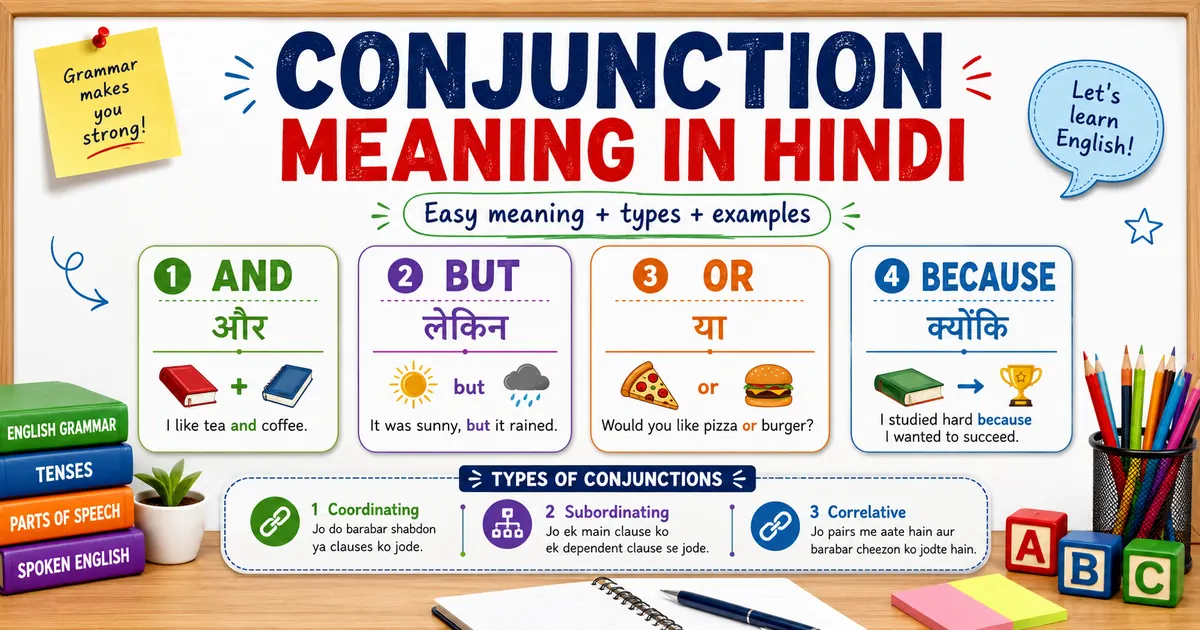
Conjunctions are small words, but they do an important job in English. They connect words, phrases, or clauses so that ideas flow naturally. In Hindi, a conjunction is commonly explained as “समुच्चयबोधक अव्यय” or a joining word.
For example: “Riya studies hard and she helps her friends.” Here, “and” joins two related ideas.
The simplest conjunction meaning in Hindi is: ऐसा शब्द जो दो शब्दों, वाक्यांशों या वाक्यों को जोड़ता है। In this lesson, you will learn the main types of conjunctions, Hindi meanings, easy examples, common mistakes, and a short practice exercise.
If you are building your grammar step by step, explore our Grammar lessons.
What Is a Conjunction?
A conjunction is a word that connects words, phrases, or clauses. Common conjunctions include and, but, or, because, although, if, while, and so. Cambridge Dictionary also describes conjunctions as linking words such as and, or, but, then, and because.
| English definition | A word that joins words, phrases, or clauses. |
| Hindi meaning | समुच्चयबोधक अव्यय, यानी जोड़ने वाला शब्द। |
Three Main Types of Conjunctions
For everyday English learning, conjunctions are easiest to understand in three main groups: coordinating, subordinating, and correlative conjunctions.
1. Coordinating Conjunctions
Coordinating conjunctions join words, phrases, or independent clauses of equal importance. The seven common coordinating conjunctions are remembered with the word FANBOYS: For, And, Nor, But, Or, Yet, So.
| Conjunction | Hindi Meaning | Example | Hindi Sense |
| and | और / तथा | Aman bought a notebook and a pen. | अमन ने एक नोटबुक और एक पेन खरीदा। |
| but | लेकिन | Priya was tired, but she finished her homework. | प्रिया थकी थी, लेकिन उसने होमवर्क पूरा किया। |
| or | या | Would you like tea or coffee? | आप चाय या कॉफी लेंगे? |
| so | इसलिए | It was raining, so we stayed inside. | बारिश हो रही थी, इसलिए हम अंदर रहे। |
| yet | फिर भी | The task was difficult, yet he completed it. | काम कठिन था, फिर भी उसने पूरा किया। |
| for | क्योंकि | She went home, for she was unwell. | वह घर गई, क्योंकि उसकी तबीयत ठीक नहीं थी। |
| nor | न ही | He did not call, nor did he message. | उसने न फोन किया, न संदेश भेजा। |
2. Subordinating Conjunctions
A subordinating conjunction connects a dependent clause to a main clause. It can show reason, time, condition, contrast, or purpose.
| Conjunction | Hindi Meaning | Example |
| because | क्योंकि | I stayed home because I had a fever. |
| although | हालाँकि / यद्यपि | Although the test was difficult, Rohan stayed calm. |
| if | यदि / अगर | You will improve if you practise daily. |
| unless | जब तक नहीं / यदि नहीं | You cannot enter unless you have an ID card. |
| when | जब | Call me when you reach home. |
| while | जबकि / दौरान | She listened while the teacher explained. |
| before | पहले | Wash your hands before you eat. |
| after | बाद में / के बाद | We went home after the class ended. |
| since | चूँकि / जब से | Since it was late, we left. |
| until | जब तक | Wait here until the bus arrives. |
3. Correlative Conjunctions
Correlative conjunctions work in pairs. The two parts of the pair connect equal grammatical elements in a sentence.
both … and (दोनों … और): Both Neha and Aditi joined the class.
either … or (या तो … या): You can either call me or send an email.
neither … nor (न तो … न ही): Neither Raj nor Mohan was absent.
not only … but also (न केवल … बल्कि … भी): She is not only intelligent but also hardworking.
whether … or (चाहे … या): I do not know whether he will come or stay home.
40 Useful Conjunctions With Hindi Meanings
| Conjunction | Hindi Meaning | Conjunction | Hindi Meaning |
| and | और | but | लेकिन |
| or | या | so | इसलिए |
| yet | फिर भी | for | क्योंकि |
| nor | न ही | because | क्योंकि |
| although | हालाँकि | though | हालाँकि |
| even though | भले ही | if | यदि |
| unless | यदि नहीं | when | जब |
| whenever | जब भी | while | जबकि / दौरान |
| before | पहले | after | बाद में |
| until | जब तक | since | चूँकि / जब से |
| as | क्योंकि / जैसे | as soon as | जैसे ही |
| once | एक बार जब | wherever | जहाँ भी |
| whereas | जबकि | than | से |
| so that | ताकि | in case | यदि ऐसा हो |
| provided that | बशर्ते कि | as long as | जब तक / बशर्ते |
| both … and | दोनों … और | either … or | या तो … या |
| neither … nor | न तो … न ही | not only … but also | न केवल … बल्कि … भी |
| whether … or | चाहे … या | rather than | की बजाय |
| even if | भले ही | now that | अब जबकि |
| as if | मानो | as though | मानो |
Easy Rules for Using Conjunctions Correctly
Do Not Use “Because” and “So” Together
A common learner mistake is using both words to show the same cause-and-result relationship.
Incorrect: Because I was tired, so I went to bed.
Correct: Because I was tired, I went to bed.
Also correct: I was tired, so I went to bed.
Do Not Use “Although” and “But” Together
Incorrect: Although it was raining, but we played.
Correct: Although it was raining, we played.
Also correct: It was raining, but we played.
Keep Paired Conjunctions Parallel
With pairs such as both … and and either … or, the connected parts should have the same grammatical form.
Better: She likes both reading and writing.
Not: She likes both reading and to write.
Either…Or and Neither…Nor: Check the Verb
When two different subjects are joined by either … or or neither … nor, the verb normally agrees with the subject closest to it in standard usage.
Neither the teacher nor the students are ready.
Neither the students nor the teacher is ready.
Common Mistakes Indian Learners Should Avoid
Using “and” in every sentence. Choose a conjunction that shows the real relationship, such as contrast, reason, choice, or condition.
Translating directly from Hindi without checking English word order. Learn conjunctions inside complete sentences.
Confusing “because” with “because of”. “Because” is followed by a clause, while “because of” is followed by a noun or noun phrase.
Forgetting the second half of a correlative pair. If you write “either”, make sure the matching “or” appears in the correct place.
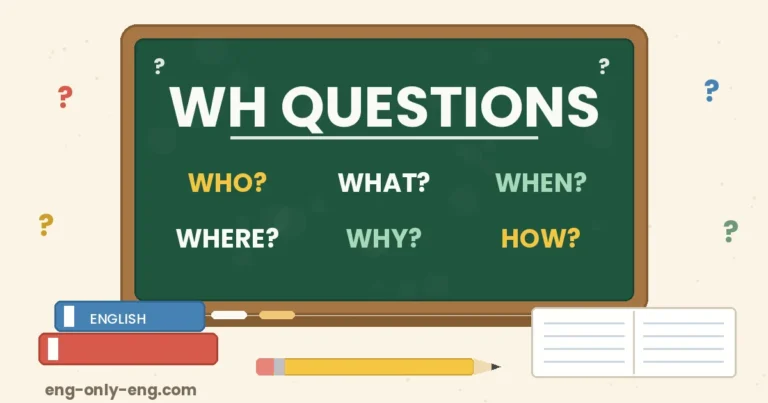
For another lesson on how English words build clear sentence patterns, read What Are Question Words? Definition, List, and Examples.
Quick Practice: Choose the Correct Conjunction
1. I wanted to go outside, ______ it was raining. (but / because)
2. You can take the bus ______ the metro. (or / yet)
3. Meera stayed home ______ she was unwell. (because / and)
4. ______ you practise every day, your English will improve. (If / Nor)
5. ______ Ravi ______ Aman was selected. (Neither … nor / Because … so)
6. We waited ______ the teacher arrived. (until / but)
7. She is ______ polite ______ helpful. (both … and / either … or)
8. ______ the road was busy, we arrived on time. (Although / So)
Answers
1. but; 2. or; 3. because; 4. If; 5. Neither … nor; 6. until; 7. both … and; 8. Although.
Frequently Asked Questions
What is the conjunction meaning in Hindi?
Conjunction का Hindi meaning “समुच्चयबोधक अव्यय” होता है। यह ऐसा शब्द है जो शब्दों, phrases, या clauses को जोड़ता है।
What are five common conjunctions?
Five common conjunctions are and, but, or, because, and so.
What are the three main types of conjunctions?
The three main types are coordinating conjunctions, subordinating conjunctions, and correlative conjunctions.
Is “because” a conjunction?
Yes. “Because” is a subordinating conjunction used to introduce a reason.
What is the difference between “and” and “but”?
“And” adds a similar or additional idea. “But” introduces a contrast.
How can I learn conjunctions quickly?
Learn them by function, such as addition, contrast, reason, choice, time, and condition. Then practise each word in a complete sentence.
Conclusion
Conjunctions help you connect ideas clearly instead of speaking or writing in broken sentences. Start with common words such as and, but, or, because, so, and if. Then move to paired forms such as both … and and either … or. The key is not to memorise a long list only. Understand what relationship each conjunction shows and practise it in a complete sentence.
For more simple English lessons for learners in India, visit Eng Only Eng. For a detailed British English reference, see Cambridge Dictionary: Conjunctions.