Sight Words: 100 Common Words with Examples and Practice
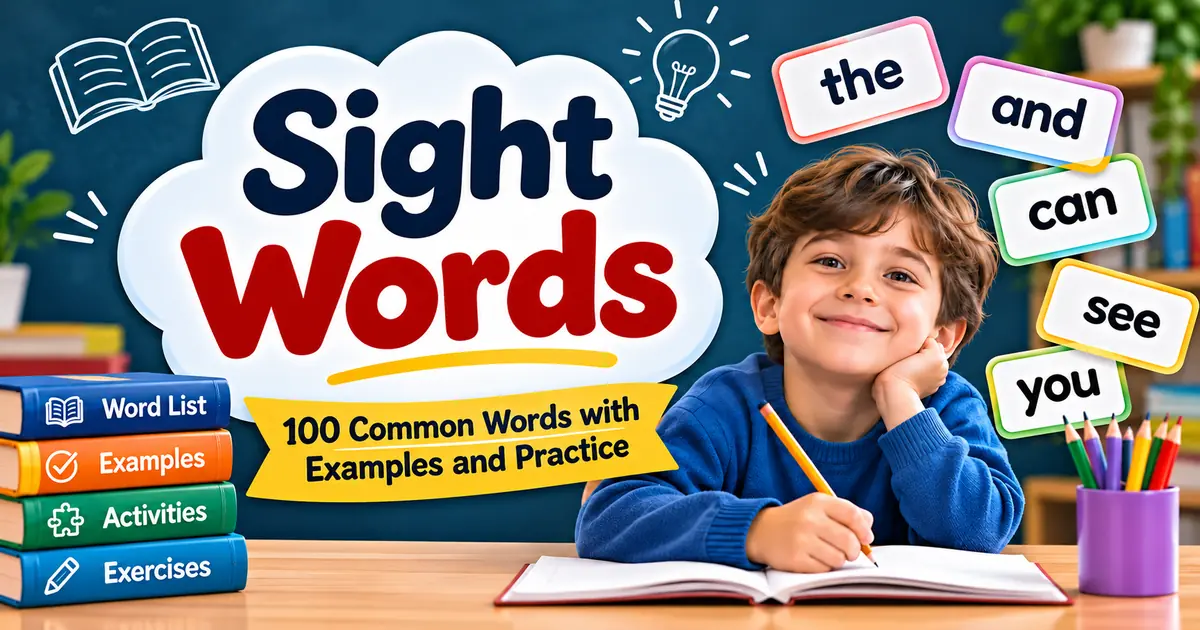
Sight words are an important part of learning to read English. Words such as the, said, you, come, and where appear regularly in children’s books and everyday sentences.
When children recognise these words quickly, they can read more smoothly and focus on understanding the sentence.
In this guide, you will learn what sight words are, explore 100 common examples, practise using them in sentences, and discover simple activities to improve reading skills.
What Are Sight Words?
Sight words are words that readers recognise immediately without needing to sound out every letter.
For example, when an experienced reader sees the word the, they recognise it automatically.
Beginning readers may need to practise reading the word several times before recognising it quickly.
Some sight words follow regular spelling patterns, while others have unusual spelling patterns.
Examples include:
- Can – I can swim.
- Look – Look at the bird.
- Said – She said hello.
- Come – Come here, please.
- Where – Where is my bag?
Learning sight words does not mean memorising every word as a picture. Children should also learn how letters represent sounds.
Why Are Sight Words Important?
Recognising familiar words quickly can make reading easier and more enjoyable.
Sight word learning helps children:
- Improve reading fluency: Read familiar words without stopping repeatedly.
- Understand sentences: Spend more attention on the meaning of a story.
- Develop reading confidence: Read simple sentences more independently.
- Improve spelling: Become familiar with common letter patterns through reading and writing.
- Build reading skills: Recognise words frequently found in books and classroom activities.
Sight word practice works best alongside phonics, spelling, and meaningful reading activities.
100 Common Sight Words List
The following 100 words are useful for early reading practice. They are grouped into sets of 20 to make learning manageable.
These are suggested practice groups, not official grade-level lists.
Sight Words List 1: Words 1–20
| No. | Sight Word | No. | Sight Word |
|---|---|---|---|
| 1 | a | 11 | is |
| 2 | I | 12 | it |
| 3 | am | 13 | me |
| 4 | an | 14 | my |
| 5 | and | 15 | no |
| 6 | at | 16 | on |
| 7 | can | 17 | see |
| 8 | go | 18 | the |
| 9 | he | 19 | to |
| 10 | in | 20 | we |
Practice sentences:
- I am happy.
- We can go.
- The cat is on the bed.
- He can see me.
Sight Words List 2: Words 21–40
| No. | Sight Word | No. | Sight Word |
|---|---|---|---|
| 21 | all | 31 | not |
| 22 | are | 32 | one |
| 23 | be | 33 | out |
| 24 | big | 34 | play |
| 25 | blue | 35 | red |
| 26 | come | 36 | run |
| 27 | down | 37 | she |
| 28 | for | 38 | up |
| 29 | here | 39 | you |
| 30 | look | 40 | yes |
Practice sentences:
- Come here, please.
- Look at the blue sky.
- She can run fast.
- Yes, you can play.
Sight Words List 3: Words 41–60
| No. | Sight Word | No. | Sight Word |
|---|---|---|---|
| 41 | after | 51 | little |
| 42 | again | 52 | make |
| 43 | ask | 53 | now |
| 44 | away | 54 | said |
| 45 | do | 55 | some |
| 46 | find | 56 | that |
| 47 | get | 57 | there |
| 48 | give | 58 | this |
| 49 | have | 59 | was |
| 50 | help | 60 | with |
Practice sentences:
- Please help me.
- I have a little dog.
- She said that she was happy.
- Can you find my book?
Sight Words List 4: Words 61–80
| No. | Sight Word | No. | Sight Word |
|---|---|---|---|
| 61 | about | 71 | like |
| 62 | because | 72 | must |
| 63 | before | 73 | new |
| 64 | but | 74 | our |
| 65 | could | 75 | over |
| 66 | did | 76 | take |
| 67 | every | 77 | them |
| 68 | from | 78 | they |
| 69 | had | 79 | want |
| 70 | has | 80 | when |
Practice sentences:
- They want a new toy.
- I like our school.
- We must help them.
- When did you come home?
Sight Words List 5: Words 81–100
| No. | Sight Word | No. | Sight Word |
|---|---|---|---|
| 81 | always | 91 | should |
| 82 | around | 92 | their |
| 83 | been | 93 | these |
| 84 | both | 94 | those |
| 85 | does | 95 | very |
| 86 | first | 96 | were |
| 87 | many | 97 | what |
| 88 | only | 98 | where |
| 89 | other | 99 | which |
| 90 | people | 100 | would |
Practice sentences:
- Where are those books?
- Many people were outside.
- We should always be kind.
- Which book would you like?
Sight Words by Learning Level
Teachers often use the Dolch word lists to organise early reading practice.
The traditional Dolch collection contains 220 service words divided into five levels, plus a separate list of 95 common nouns.
| Level | Number of Words |
|---|---|
| Pre-Primer | 40 |
| Primer | 52 |
| First Grade | 41 |
| Second Grade | 46 |
| Third Grade | 41 |
| Total | 220 |
These levels are traditional guides. Children may learn words at different speeds depending on their reading experience and phonics knowledge.
You can explore the Dolch Word List from the University of Utah Reading Clinic for additional reading practice.
Sight Words vs. Phonics Words
Sight words and phonics are connected, but they are not the same thing.
| Sight Words | Phonics |
|---|---|
| Words recognised automatically | A method of reading using letter-sound relationships |
| Can have regular or irregular spelling | Helps learners decode unfamiliar words |
| Develop through repeated accurate reading | Provides tools for sounding out words |
| Examples: the, said, can | Examples of decodable words: cat, pin, stop |
A word like can can be sounded out using phonics. With practice, a child may recognise it instantly.
The word said contains a less familiar spelling pattern, so its pronunciation and letter-sound connections need careful attention.
Some spelling patterns also involve silent letters. Our guide to silent letters in English explains several useful examples.
How to Teach Sight Words Easily
1. Start With a Few Words
Choose three to five useful words, such as the, I, can, see, and you.
Introduce more words after the child becomes comfortable reading the first group.
2. Connect Letters With Sounds
Say the word aloud and ask the child to notice its letters.
For example, in can, practise the sounds /k/, /a/, and /n/, then blend them together.
For irregular words, explain which spelling parts are unexpected.
3. Use Sight Word Flashcards
Write one word on each card.
Show the card, ask the child to read it, and provide help when necessary.
Review familiar cards alongside new ones.
4. Practise With Sentences
Instead of reading isolated words all the time, use them in meaningful sentences.
For example:
- I can see you.
- We go to school.
- The dog is big.
5. Read and Write Daily
Encourage children to read short stories and write familiar words.
A few minutes of focused practice each day can provide regular opportunities to strengthen word recognition.
Fun Sight Word Activities for Kids
Sight Word Hunt: Write several familiar words on paper. Ask children to find and circle a particular word.
Word Matching: Prepare two cards for each word. Mix the cards and ask children to find matching pairs.
Build a Sentence: Give children word cards such as I, can, see, and you. Ask them to arrange the cards into a meaningful sentence.
Missing Word Game: Read a sentence with one word missing and ask the child to choose the correct word.
These activities combine word recognition with reading, spelling, and understanding.
Sight Words Practice Exercises
Exercise 1: Fill in the Blanks
Choose the correct word from the brackets.
- I ___ a student. (am / is)
- She ___ a book. (have / has)
- ___ is my pencil? (Where / When)
- We ___ play outside. (can / was)
- The dog is ___ the table. (on / he)
Exercise 2: Arrange the Words
Put the words in the correct order.
- can / I / swim
- is / the / big / house
- see / we / a / bird
- like / I / school
- are / they / happy
Answers
Exercise 1: 1. am, 2. has, 3. Where, 4. can, 5. on.
Exercise 2:
- I can swim.
- The house is big.
- We see a bird.
- I like school.
- They are happy.
Frequently Asked Questions
What are sight words?
Sight words are words that readers recognise immediately without consciously sounding them out. Both regularly and irregularly spelled words can become sight words.
What are 10 common sight words?
Ten useful examples are the, a, I, you, to, and, is, it, we, and can.
Are sight words and high-frequency words the same?
Not exactly. High-frequency words appear often in written language. Sight words are words an individual reader recognises automatically. Many high-frequency words become sight words through practice.
How many sight words should a child learn?
There is no single number suitable for every child. Teachers should consider reading ability, phonics knowledge, and progress rather than focusing only on memorising a particular number.
Can sight words be sounded out?
Yes. Many sight words follow regular phonics patterns. Others contain unusual spelling patterns that require additional explanation and practice.
What is the best way to practise sight words?
Combine phonics, repeated reading, spelling, flashcards, and short sentences. Practise a manageable number of words and review them regularly.
Conclusion
Sight words help children recognise familiar words quickly and read English more fluently.
Begin with useful words, practise their letter-sound patterns, and use them in meaningful sentences. Reading stories, writing words, and playing simple word games can make learning more effective.
Remember that sight word recognition develops alongside phonics. Both are important for building strong, confident readers.