Homonyms Examples: 30 Common Words With Meanings and Sentences
English has many words that look and sound exactly the same but have completely different meanings. These words are called homonyms.
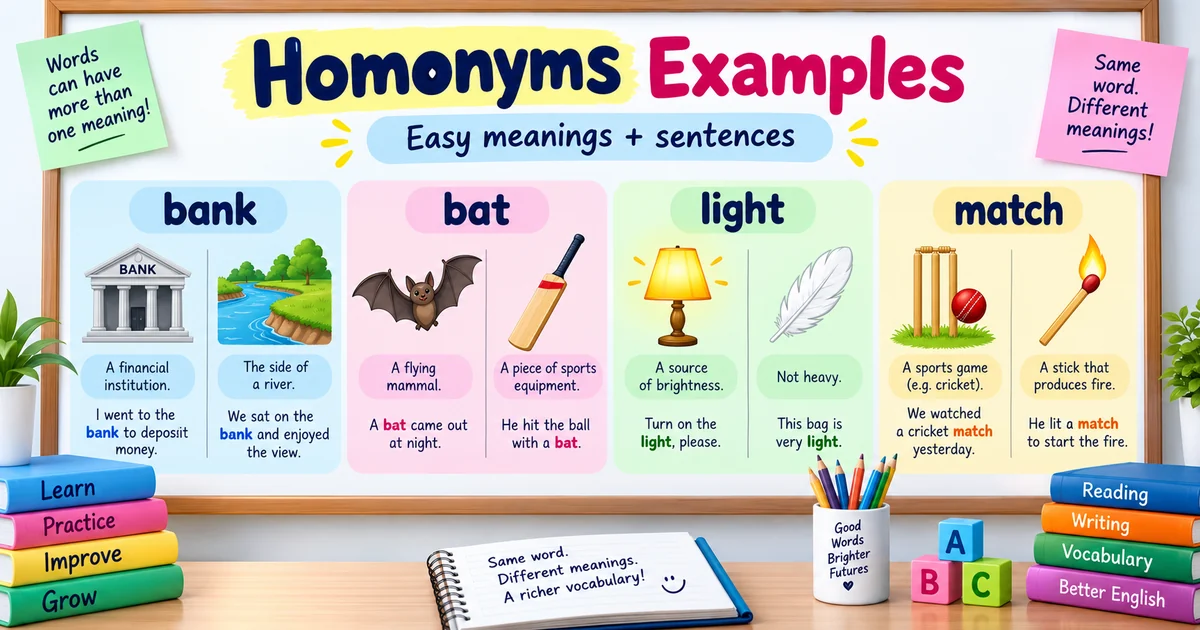
For example, the word “bank” can mean a place where money is kept. It can also mean the land beside a river.
The spelling is the same. The pronunciation is the same. Only the meaning changes.
Learning common homonyms examples helps you understand sentences from context, improve vocabulary, avoid confusion and become a better reader and writer.
You can also explore more word based lessons in the Eng Only Eng Vocabulary section. Vocabulary lessons
What Are Homonyms?
A homonym is a word that shares its spelling or pronunciation with another word but has a different meaning.
The term “homonym” is used in slightly different ways by dictionaries and grammar references. Merriam-Webster, for example, recognises that homonyms can include homophones, homographs and words that are both spelled and pronounced alike but have different meanings. (Merriam-Webster)
For this lesson, we will focus mainly on the easiest type for learners to understand:
Same spelling + same pronunciation + different meaning
Example:
Bank = a financial institution
Bank = the side of a river
Sentence 1:
My father went to the bank to deposit money.
Sentence 2:
We sat on the river bank and watched the water.
The word “bank” remains the same, but the sentence tells us which meaning is intended.
30 Common Homonyms Examples
Here are useful homonyms that students often see in everyday English.
| Homonym | Meaning 1 | Meaning 2 |
|---|---|---|
| bank | place for money | side of a river |
| bat | flying animal | sports equipment |
| bark | sound made by a dog | outer covering of a tree |
| bear | large animal | tolerate or carry |
| book | written work | reserve something |
| bowl | round container | deliver a ball in cricket |
| can | be able to | metal container |
| date | calendar day | fruit |
| fair | reasonable | public event |
| file | collection of documents | tool for smoothing |
| fly | move through the air | small insect |
| jam | fruit spread | traffic blockage |
| kind | type | caring |
| letter | alphabet symbol | written message |
| light | brightness | not heavy |
| match | sporting contest | small stick used to make fire |
| nail | part of a finger | small metal fastener |
| park | public green area | leave a vehicle |
| pupil | student | centre part of the eye |
| ring | circular jewellery | sound made by a phone |
| rock | stone | move gently backwards and forwards |
| rose | flower | past tense of rise |
| saw | cutting tool | past tense of see |
| spring | season | coiled piece of metal |
| tie | clothing worn around the neck | equal result |
| train | railway vehicle | teach or practise |
| watch | look carefully | small clock worn on the wrist |
| wave | movement of water | move your hand in greeting |
| well | in a good way | deep hole for water |
| point | sharp end | idea or purpose |
Homonyms Examples in Sentences
Seeing each word in context makes the meanings much easier to understand.
1. Bank
Meaning 1: A place where people keep money.
I went to the bank after school.
Meaning 2: Land beside a river.
The children sat on the river bank.
2. Bat
Meaning 1: A flying animal.
A bat came out of the cave at night.
Meaning 2: Equipment used in games such as cricket.
Rahul bought a new cricket bat.
3. Bark
Meaning 1: The sound made by a dog.
We heard the dog bark outside.
Meaning 2: The outer layer of a tree.
The bark of this tree is very rough.
4. Book
Meaning 1: Something that we read.
Priya borrowed an English book.
Meaning 2: To reserve something.
We need to book our seats in advance.
5. Bowl
Meaning 1: A round container.
She put the fruit in a bowl.
Meaning 2: To deliver the ball in cricket.
Arjun can bowl very fast.
6. Date
Meaning 1: A particular day.
What is today’s date?
Meaning 2: A sweet fruit.
He ate two dates after lunch.
7. Fair
Meaning 1: Reasonable and just.
The teacher made a fair decision.
Meaning 2: A public event with activities and stalls.
Our school organised a book fair.
8. Jam
Meaning 1: A sweet fruit spread.
I had bread and strawberry jam for breakfast.
Meaning 2: A situation where vehicles cannot move easily.
We were late because of a traffic jam.
9. Light
Meaning 1: Brightness.
Please turn on the light.
Meaning 2: Not heavy.
This school bag is very light.
10. Match
Meaning 1: A sporting contest.
We watched a cricket match yesterday.
Meaning 2: A small stick used to start a fire.
He used a match to light the candle.
11. Pupil
Meaning 1: A student.
Every pupil completed the exercise.
Meaning 2: The dark opening in the centre of the eye.
The pupil becomes larger in dim light.
12. Ring
Meaning 1: A piece of jewellery.
She found a gold ring.
Meaning 2: The sound of a telephone or bell.
I heard the phone ring.
13. Spring
Meaning 1: A season of the year.
Flowers begin to grow in spring.
Meaning 2: A coiled piece of metal.
The spring inside the toy was damaged.
14. Train
Meaning 1: A railway vehicle.
We travelled to Delhi by train.
Meaning 2: To teach or practise for a particular skill.
The players train every morning.
15. Watch
Meaning 1: To look at something carefully.
We watched the teacher demonstrate the experiment.
Meaning 2: A small clock worn on the wrist.
My watch says it is nine o’clock.
How Does Context Help With Homonyms?
The most important skill when learning homonyms is understanding context.
Look at these sentences:
The bat flew across the sky.
He hit the ball with a bat.
You do not need another spelling to identify the meaning. The words around “bat” provide the answer.
In the first sentence, “flew” and “sky” tell us that the word means an animal.
In the second sentence, “hit” and “ball” tell us that the word means sports equipment.
When you meet an unfamiliar meaning, read the entire sentence before checking a dictionary.
Homonyms vs Homophones vs Homographs
These three terms are often confused.
| Term | Main Idea | Example |
|---|---|---|
| Homonym | same spelling or sound, different meaning | bank / bank |
| Homophone | same sound, different meaning | sea / see |
| Homograph | same spelling, different meaning | lead / lead |
A homophone focuses on pronunciation.
For example:
sea / see
right / write
flower / flour
A homograph focuses on spelling. Some homographs have different pronunciations.
For example:
“lead” meaning to guide
“lead” meaning the metal
Because dictionaries and language specialists sometimes use “homonym” as a broader category, you may see slightly different classifications. Cambridge also describes homonyms as words that sound the same or are spelled the same but have different meanings. (Cambridge Dictionary)
If you are studying words with identical sounds but different spellings, treat them separately as homophones. This prevents confusion between the two lessons.
Why Are Homonyms Important for English Learners?
Homonyms teach you an important English skill: understanding meaning through context.
Consider this sentence:
The students watched the match.
The word “match” means a sporting contest here.
Now compare:
He lit the candle with a match.
The same word has a completely different meaning.
Learning homonyms can improve:
Vocabulary
Reading comprehension
Sentence understanding
Writing
Speaking
Exam performance
Dictionary skills
It also teaches you not to assume that a familiar word always has only one meaning.
Common Mistakes to Avoid
Mistake 1: Assuming One Word Has Only One Meaning
A learner may know that “park” is a public place but become confused by:
Please park the car here.
In this sentence, “park” is a verb.
Always check how the word is being used.
Mistake 2: Confusing Homonyms With Homophones
“Sea” and “see” sound alike but have different spellings.
They are homophones.
“Bank” and “bank” have the same spelling and pronunciation but different meanings.
They are a common example of homonyms.
Mistake 3: Ignoring the Sentence Around the Word
Do not translate or define a word before reading the entire sentence.
Context usually tells you the correct meaning.
Mistake 4: Learning Only Definitions
Use every new homonym in two different sentences.
For example:
The bird can fly.
A fly landed on the table.
This helps your brain connect one word with two meanings.
For more spelling and pronunciation practice, you can also study the Eng Only Eng lesson on silent letters. Silent Letters Words in English
Easy Homonyms Practice Exercise
Choose the correct meaning of the bold word.
- We sat on the bank of the river.
a. Financial institution
b. Land beside a river
- The dog began to bark.
a. Tree covering
b. Dog sound
- Please book two seats.
a. Reserve
b. Something to read
- The bag is very light.
a. Not heavy
b. Brightness
- India won the match.
a. Sporting contest
b. Stick used to make fire
- The pupil answered the question.
a. Student
b. Part of the eye
- Please park the car outside.
a. Public garden
b. Leave a vehicle
- My phone began to ring.
a. Make a sound
b. Jewellery
Answers
- b. Land beside a river
- b. Dog sound
- a. Reserve
- a. Not heavy
- a. Sporting contest
- a. Student
- b. Leave a vehicle
- a. Make a sound
Frequently Asked Questions
What are homonyms?
Homonyms are words that have the same spelling or pronunciation but different meanings.
What are five examples of homonyms?
Five common examples are bank, bat, bark, light and match. Each of these words can have more than one meaning.
Is “bank” a homonym?
Yes. “Bank” can mean a financial institution or the land beside a river.
Is “bat” a homonym?
Yes. A bat can be a flying animal or a piece of sports equipment.
Are homonyms and homophones the same?
Not exactly. Homophone specifically refers to words with the same pronunciation but different meanings. “Homonym” is used more broadly and its precise definition can vary between dictionaries.
How can I identify a homonym?
Read the whole sentence. Look at nearby words and decide which meaning makes sense in that context.
Why should students learn homonyms?
Homonyms help students build vocabulary, understand context and avoid confusion when reading or writing.
Conclusion
Homonyms show us that one English word can sometimes carry very different meanings.
“Bank” can relate to money or a river. “Bat” can describe an animal or sports equipment. “Light” can mean brightness or something that is not heavy.
The easiest way to master homonyms is not to memorise definitions alone. Learn each meaning with its own sentence and use context to decide what the word means.
Practise a few examples every day, and words that once seemed confusing will become much easier to understand.
For more simple English lessons, vocabulary guides and practice resources, visit Eng Only Eng. Eng Only Eng
For an authoritative reference on the different ways the term “homonym” is used, see Merriam-Webster’s homonym entry. Merriam-Webster: Homonym