Subject and Predicate Examples: 50 Sentences, Rules and Exercises
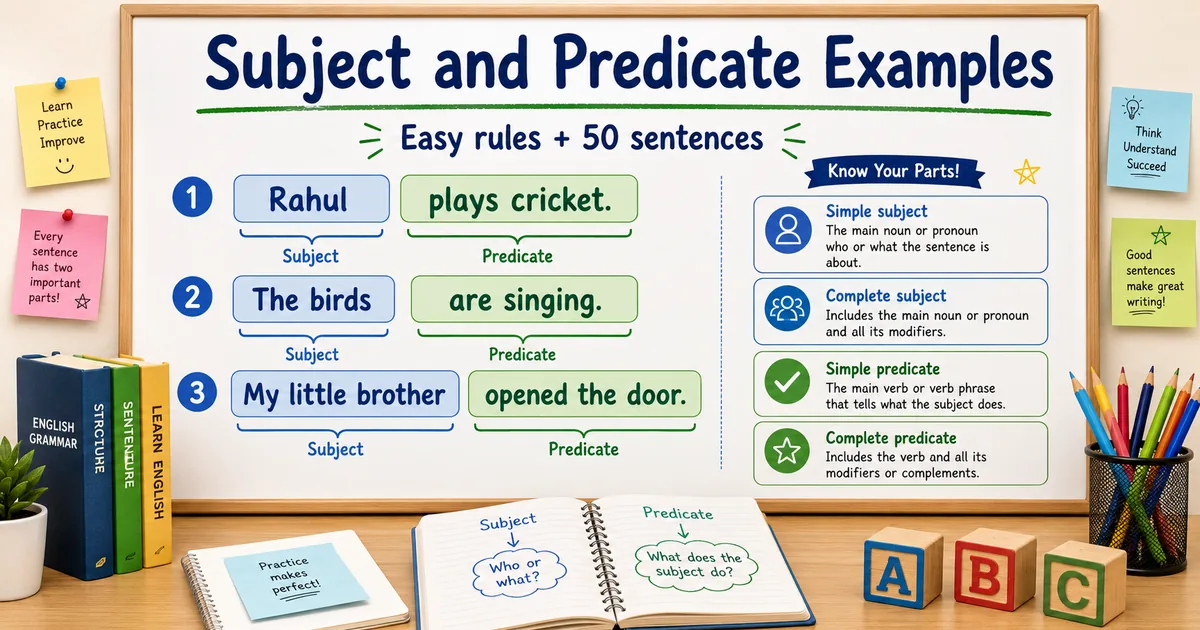
The subject and predicate are two basic parts of sentence structure. The subject tells who or what the sentence is about. The predicate tells what the subject does, is, has, or experiences.
In “The students are revising for the test,” “The students” is the subject and “are revising for the test” is the predicate.
This lesson gives you 50 examples, simple rules, common mistakes, and a short exercise with answers.
For more lessons on sentence structure and grammar, explore our Grammar section.
What Are Subject and Predicate?
The subject is who or what the sentence is about. It is usually a noun, pronoun, or noun phrase.
The predicate tells something about the subject and always contains a verb. It may also include objects, complements, or modifiers.
Cambridge Grammar explains that subjects are a major element of clause structure and are typically noun phrases. You can read its guide to subjects for a deeper reference.
| Sentence | Subject | Predicate |
| The baby is sleeping. | The baby | is sleeping. |
| Rahul opened the window. | Rahul | opened the window. |
| Our classroom looks clean. | Our classroom | looks clean. |
Subject vs Predicate: The Main Difference
| Feature | Subject | Predicate |
| Main job | Tells who or what the sentence is about | Tells what the subject does, is, has, or experiences |
| Usually contains | A noun, pronoun, or noun phrase | A verb plus any words connected to it |
| Example | The school bus | arrived early. |
| Question to ask | Who or what? | What about the subject? |
How to Identify the Subject and Predicate
Use this three-step method whenever you are unsure:
1. Find the main verb. In “The children played outside,” the main verb is “played.”
2. Ask who or what does the verb or is being described. Who played? The children. That is the subject.
3. Put the verb and the rest of the information together. “Played outside” is the predicate.
Questions and commands need a little more care, as shown later.
50 Subject and Predicate Examples
Combine each subject with its predicate to read the complete sentence. The examples move from simple patterns to questions and commands.
| No. | Subject | Predicate |
| 1 | The sun | shines brightly. |
| 2 | Birds | build nests. |
| 3 | My brother | plays football. |
| 4 | The baby | is crying. |
| 5 | Our teacher | explained the lesson. |
| 6 | The train | arrived late. |
| 7 | Priya | reads every evening. |
| 8 | The flowers | smell sweet. |
| 9 | My parents | work hard. |
| 10 | The dog | barked loudly. |
| 11 | The students | are writing notes. |
| 12 | Our school | opens at eight. |
| 13 | Rohan | completed his homework. |
| 14 | The children | were playing in the park. |
| 15 | This book | belongs to me. |
| 16 | The old clock | stopped suddenly. |
| 17 | My best friend | lives in Delhi. |
| 18 | The science class | was interesting. |
| 19 | A small bird | sat on the wall. |
| 20 | The blue bag | is mine. |
| 21 | Ali and Hamza | study together. |
| 22 | Tea and coffee | are available. |
| 23 | The teacher and the principal | attended the meeting. |
| 24 | Riya | sings and dances well. |
| 25 | The boys | laughed and clapped. |
| 26 | My younger sister | can speak English confidently. |
| 27 | The students in the front row | answered quickly. |
| 28 | The new computer in our office | works perfectly. |
| 29 | The tall trees near the gate | provide shade. |
| 30 | Our English teacher | gave us extra practice. |
| 31 | The final exam | begins next Monday. |
| 32 | The roads | were crowded in the morning. |
| 33 | The library | has many useful books. |
| 34 | A good dictionary | helps language learners. |
| 35 | The results | will be announced tomorrow. |
| 36 | The homework | was checked by the teacher. |
| 37 | My phone | has stopped working. |
| 38 | Everyone in the class | understood the rule. |
| 39 | Nobody | knew the correct answer. |
| 40 | Something strange | happened yesterday. |
| 41 | The boy wearing a red cap | is my cousin. |
| 42 | The students who arrived early | found seats. |
| 43 | Reading English stories | improves vocabulary. |
| 44 | Learning grammar | takes regular practice. |
| 45 | To speak clearly | requires confidence and practice. |
| 46 | Three books | are on the desk. |
| 47 | It | is raining heavily today. |
| 48 | Rahul | submitted the form. |
| 49 | The students | are going to the library. |
| 50 | You | should close the door. |
Simple, Complete and Compound Subjects
A simple subject is the main noun or pronoun. A complete subject includes that word plus its describing words.
Example: “The three new students joined our class.” Simple subject: students. Complete subject: The three new students.
A compound subject contains two or more subjects that share the same predicate. Example: “Ravi and Meera study together.” Compound subject: Ravi and Meera.
Simple, Complete and Compound Predicates
A simple predicate is the main verb or verb phrase. A complete predicate includes the verb and its related words.
Example: “The children played football after school.” Simple predicate: played. Complete predicate: played football after school.
A compound predicate contains two or more verbs or verb phrases that share one subject. Example: “Neha opened the book and started reading.” Compound predicate: opened the book and started reading.
Special Cases Learners Should Know
Commands have an understood subject: In “Sit down,” the subject “you” is understood even though it is not written. The predicate is “sit down.”
Questions may change normal word order: In “Did Arjun call you?” the subject is “Arjun” even though the auxiliary verb “did” comes before it.
The subject is not always the doer: In passive sentences, the subject can receive the action. In “The letter was written by Kavya,” the subject is “The letter” and the predicate is “was written by Kavya.”
Do not confuse an object with the subject: In “Rita opened the box,” Rita is the subject. “The box” is the object because it receives the action.
If you need a quick review of nouns, pronouns, verbs and other word classes that appear inside subjects and predicates, read our 8 Parts of Speech guide.
Common Mistakes to Avoid
Mistake 1: Choosing only the first word as the subject. In “The students in Class 8 are preparing for the exam,” the complete subject is “The students in Class 8,” not only “The.”
Mistake 2: Leaving the verb out of the predicate. A predicate must contain a verb. In “The bus arrived at noon,” the predicate is “arrived at noon.”
Mistake 3: Assuming the subject always comes first. Questions may place an auxiliary before the subject, and commands may leave the subject unstated.
Mistake 4: Confusing the object with the predicate. The object can be part of the predicate, but it is not the whole predicate. In “She bought a notebook,” “a notebook” is the object, while “bought a notebook” is the predicate.
Quick Practice Exercise
Identify the complete subject and complete predicate in each sentence. Try the questions before checking the answers.
1. My younger brother rides his bicycle every evening.
2. The red flowers near the window look beautiful.
3. Aman and Riya completed the project.
4. The students listened carefully to the instructions.
5. Our new English teacher speaks very clearly.
6. The old building was repaired last year.
7. The bus arrived on time.
8. Please open your notebook.
9. The books on the top shelf belong to the library.
10. Reading every day improves your English.
Answers
1. Subject: My younger brother. Predicate: rides his bicycle every evening.
2. Subject: The red flowers near the window. Predicate: look beautiful.
3. Subject: Aman and Riya. Predicate: completed the project.
4. Subject: The students. Predicate: listened carefully to the instructions.
5. Subject: Our new English teacher. Predicate: speaks very clearly.
6. Subject: The old building. Predicate: was repaired last year.
7. Subject: The bus. Predicate: arrived on time.
8. Subject: you (understood). Predicate: please open your notebook.
9. Subject: The books on the top shelf. Predicate: belong to the library.
10. Subject: Reading every day. Predicate: improves your English.
Frequently Asked Questions
What is a subject in a sentence?
The subject is who or what the sentence is about, usually a noun, pronoun, or noun phrase.
What is a predicate in a sentence?
The predicate tells what the subject does, is, has, or experiences and always contains a verb.
What is an easy subject and predicate example?
In “The cat sleeps,” “The cat” is the subject and “sleeps” is the predicate.
Can a sentence have two subjects?
Yes. A compound subject has two or more subjects sharing the same predicate, as in “Ravi and Neha study together.”
What is the subject in a command?
The subject is usually an understood “you”. In “Close the door,” the subject is “you” even though it is not written.
Conclusion
The subject tells who or what the sentence is about, while the predicate tells what happens or what the subject is like. Find the verb first, then ask who or what is connected to it. Regular practice makes longer sentences easier to understand.
For more clear English grammar lessons, examples and practice, visit Eng Only Eng.