Interjection Examples: 50+ Sentences, Types and Easy Rules
Wow! That was a great answer.
The word “Wow!” is an interjection. Interjections are short words or phrases that express a sudden feeling, reaction, greeting, hesitation, or call for attention. They are common in spoken English and informal writing.
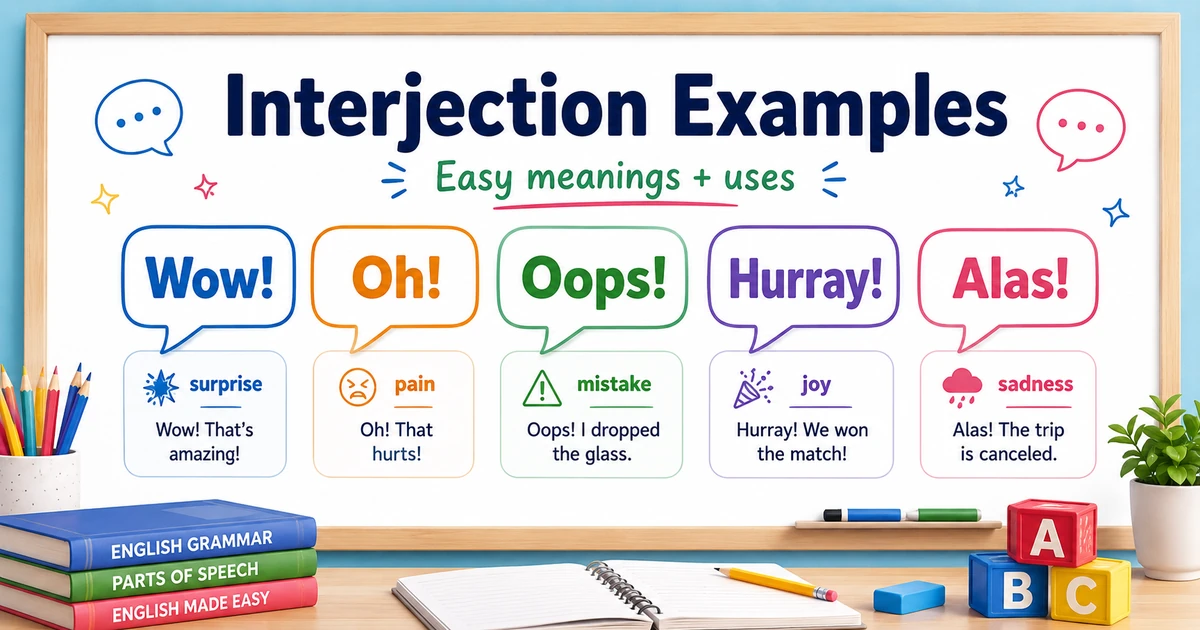
Common interjection examples include “wow”, “ouch”, “oops”, “hey”, “oh”, “phew”, “hurray”, and “alas”.
An interjection is one of the eight parts of speech, but it usually stands apart from the grammar of the rest of the sentence. If you remove it, the main sentence often remains complete.
Wow! Your project looks excellent.
Your project looks excellent.
The second sentence is still correct, but it loses the speaker’s feeling.
What Is an Interjection?
An interjection is a word or short expression used to show an immediate feeling or reaction. It can express joy, surprise, pain, disappointment, relief, greeting, hesitation, approval, or attention.
Ouch! I hurt my finger.
Yay! We finished the project.
Oh! I forgot my notebook.
Hey! Wait for me.
Phew! The exam is over.
The Cambridge Dictionary includes examples such as “Hey!” and “Ouch!” when explaining interjections.
If you are revising English grammar, explore our Grammar lessons for more simple explanations and examples.
How Do Interjections Work in a Sentence?
Interjections are flexible. They can stand alone or appear with a sentence.
At the beginning: Wow! This room looks beautiful.
As a complete reaction: Really?
Inside a sentence: The test was, well, more difficult than I expected.
At the end: We finally won, yay!
For beginners, the beginning position is the easiest pattern to recognise.
Types of Interjections With Examples
Learner books often group interjections by the feeling or purpose they express. These groups are useful for study, although the same interjection may have different meanings in different situations.
Interjections of Joy
Hurray! Our team won the match.
Yay! The holidays begin tomorrow.
Wonderful! Your pronunciation has improved.
Interjections of Surprise
Wow! That building is huge.
Oh! I did not expect to see you here.
Whoa! That bicycle is moving fast.
Interjections of Pain
Ouch! I cut my finger.
Ow! My foot hurts.
Yikes! That was close.
Interjections of Sorrow or Disappointment
Alas! The old tree was destroyed in the storm.
Oh no! I left my homework at home.
Oh dear! We missed the bus.
Interjections of Relief
Phew! I submitted the form before the deadline.
Thank goodness! The lost keys were found.
Ah! It feels good to sit down.
Interjections for Greeting or Attention
Hello! How are you?
Hey! Please look this way.
Listen! The teacher is giving an important instruction.
Interjections of Approval
Bravo! That was an excellent performance.
Well done! You answered correctly.
Great! We completed the task on time.
Interjections of Hesitation
Um, I am not sure of the answer.
Hmm, this problem needs more thought.
Well, I think the second option is better.
30 Common Interjections and Their Meanings
Here is a quick reference list of useful interjections and their common meanings.
| Interjection | Common Meaning | Example |
| Wow! | surprise or admiration | Wow! Your drawing looks excellent. |
| Ouch! | pain | Ouch! I hit my elbow. |
| Oops! | small mistake | Oops! I wrote the wrong date. |
| Yay! | joy | Yay! We have a holiday tomorrow. |
| Hurray! | celebration | Hurray! We won the final. |
| Oh! | surprise or realisation | Oh! Now I understand. |
| Oh no! | worry or disappointment | Oh no! I missed the train. |
| Phew! | relief | Phew! The test is finished. |
| Hey! | attention or greeting | Hey! Wait for me. |
| Hi! | greeting | Hi! Nice to meet you. |
| Hello! | greeting | Hello! How can I help? |
| Alas! | sorrow | Alas! The old bridge is gone. |
| Bravo! | praise | Bravo! You spoke confidently. |
| Great! | approval | Great! Your answer is correct. |
| Hmm | thought or doubt | Hmm, I need to check this. |
| Um | hesitation | Um, may I ask a question? |
| Aha! | discovery | Aha! I found the solution. |
| Ah! | realisation or relief | Ah! That makes sense. |
| Whoa! | surprise or warning | Whoa! Slow down. |
| Yikes! | fear or surprise | Yikes! That dog is very large. |
| Ugh! | dislike or frustration | Ugh! This box is heavy. |
| Yuck! | disgust | Yuck! The milk has gone sour. |
| Shh! | request for silence | Shh! The class has started. |
| Psst! | quiet attention | Psst! Your pen fell down. |
| Really? | surprise or doubt | Really? You met the author? |
| Gosh! | surprise | Gosh! That was quick. |
| Come on! | encouragement | Come on! Try once more. |
| Careful! | warning | Careful! The floor is wet. |
| Congratulations! | celebration | Congratulations! You passed. |
| Welcome! | greeting | Welcome! Please take a seat. |
Punctuation With Interjections
Punctuation depends on the strength and purpose of the reaction.
Use an exclamation mark for a strong feeling:
Wow! That is amazing.
Ouch! That hurts.
Use a comma for a milder reaction:
Well, I agree with your idea.
Oh, I see what you mean.
Use a question mark when the interjection works as a questioning reaction:
Really? You finished already?
Do not add an exclamation mark automatically. Choose punctuation that matches the tone.
Are All Interjections Strong Emotions?
No. Some interjections express strong feelings, but others have conversational jobs.
- “Um” can show hesitation.
- “Hey” can attract attention.
- “Well” can introduce a response.
- “Shh” asks someone to be quiet.
This is why context matters. One interjection can also carry different meanings depending on the situation and tone.
Interjection vs Exclamation
An interjection is a word or phrase used to express a reaction. An exclamation is a sentence or expression that shows strong feeling.
Wow!
Here, “wow” is an interjection and forms an exclamation by itself.
What a wonderful result!
This is an exclamation, but it does not contain a typical standalone interjection. The ideas overlap, but they are not exactly the same.
Common Mistakes to Avoid
1. Using an exclamation mark after every interjection. Strong reactions often use “!”, but mild interjections can take a comma.
2. Overusing interjections in formal writing. Interjections are natural in conversation, dialogue, stories, and informal messages. Use them sparingly in academic essays, reports, and formal letters.
3. Giving every interjection one fixed meaning. “Oh” can show surprise, understanding, disappointment, or realisation. Always look at the context.
4. Treating an interjection as part of the main sentence structure. In “Wow! Priya answered correctly”, “Wow!” is not the subject or verb of the main sentence.
To see how interjections fit with nouns, verbs, adjectives and other word classes, read our 8 Parts of Speech Definitions and Examples guide.
Quick Practice Exercise
Choose a suitable interjection for each sentence.
1. ______! I dropped my glass.
2. ______! We won the competition.
3. ______! My hand hurts.
4. ______, I need a minute to think.
5. ______! Please keep quiet.
6. ______! Your speech was excellent.
7. ______! I finally found my missing notebook.
8. ______? You completed all 100 questions?
9. ______! The food smells unpleasant.
10. ______! Please watch the step.
Answers
1. Oops!
2. Hurray! or Yay!
3. Ouch!
4. Hmm or Um
5. Shh!
6. Bravo! or Excellent!
7. Aha!
8. Really?
9. Yuck! or Ugh!
10. Careful!
Frequently Asked Questions
What are 10 examples of interjections?
Ten common interjections are wow, ouch, oops, yay, hey, oh, phew, bravo, alas and hmm.
What is an interjection in simple words?
An interjection is a short word or phrase that shows a sudden feeling, reaction, greeting, hesitation, or call for attention.
Can an interjection be a complete sentence?
Yes. An interjection such as “Wow!” or “Ouch!” can stand alone as a complete expression.
Does an interjection always need an exclamation mark?
No. Strong interjections often use an exclamation mark, but milder interjections may use a comma, and questioning reactions may use a question mark.
Is “well” an interjection?
It can be. In “Well, I am not sure”, “well” introduces the speaker’s reaction or response.
Are interjections used in formal writing?
They can be, but they are much more common in speech and informal writing. Formal and academic writing usually uses them sparingly.
Conclusion
Interjections make English sound more natural and expressive. Words such as “wow”, “ouch”, “oops”, “hey”, and “phew” communicate feelings and reactions quickly.
The best way to learn interjection examples is to connect each word with a real situation. Notice the feeling, choose suitable punctuation, and practise using the expression in a short sentence.
For more learner-friendly grammar and vocabulary lessons, visit Eng Only Eng.