Question Tags With Answers: Rules, 40 Examples and Exercises
You are learning English, aren’t you?
The short question “aren’t you?” at the end of that sentence is called a question tag.
Question tags are short questions added to the end of statements. We use them mainly to check information, ask for confirmation, or encourage another person to agree with us. They are especially common in spoken English.
The basic rule is simple:
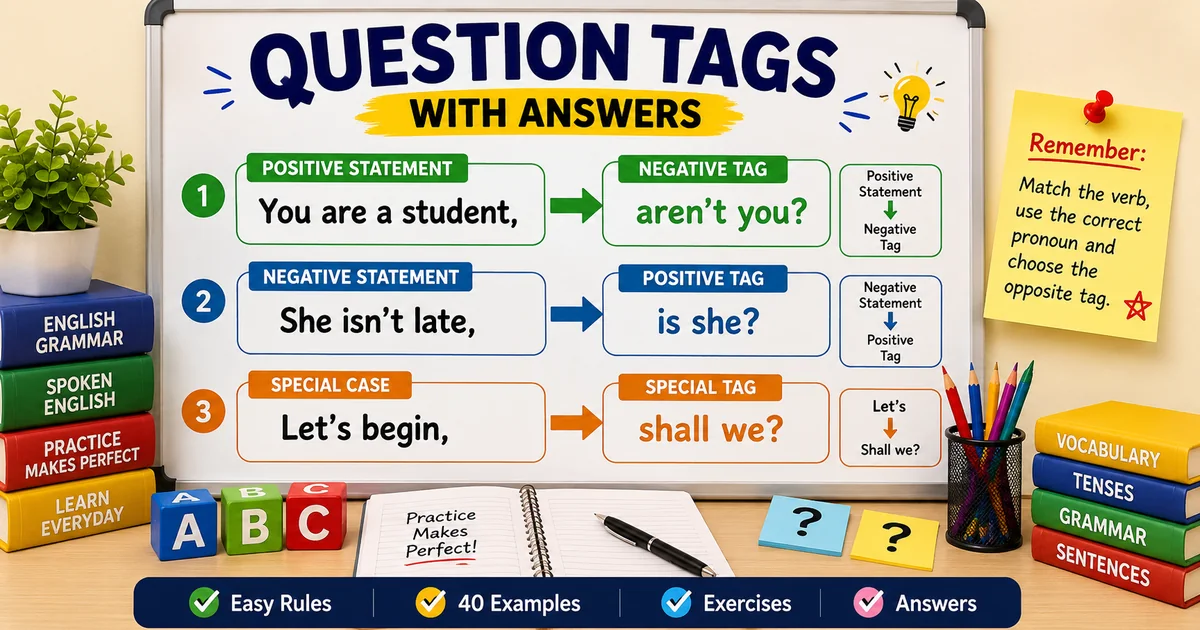
Positive statement + negative question tag
She is a student, isn’t she?
Negative statement + positive question tag
She isn’t a student, is she?
Once you understand the verb, pronoun and positive or negative pattern, question tags become much easier.
You can find more lessons like this in our Grammar section.
What Is a Question Tag?
A question tag is a short question placed after a statement.
Example:
Rahul is your brother, isn’t he?
“Rahul is your brother” is the statement.
“Isn’t he?” is the question tag.
The tag normally contains:
Auxiliary verb + pronoun
For example:
isn’t + he
haven’t + they
did + she
can’t + you
The auxiliary verb and tense should match the main statement. If there is no auxiliary verb in a simple present or simple past statement, we normally use do, does or did.
The Two Main Question Tag Rules
Rule 1: Positive Statement, Negative Tag
When the statement is positive, the tag is normally negative.
Riya is happy, isn’t she?
You like cricket, don’t you?
He finished his homework, didn’t he?
They can speak English, can’t they?
Rule 2: Negative Statement, Positive Tag
When the statement is negative, the tag is normally positive.
Riya isn’t happy, is she?
You don’t like cricket, do you?
He didn’t finish his homework, did he?
They can’t speak English, can they?
This positive and negative contrast is the main pattern taught for standard question tags.
Which Verb Should You Use?
Look at the verb in the statement first.
| Statement | Question Tag |
|---|---|
| She is ready | isn’t she? |
| They are coming | aren’t they? |
| He was absent | wasn’t he? |
| We have finished | haven’t we? |
| She can swim | can’t she? |
| You will come | won’t you? |
| Rahul plays cricket | doesn’t he? |
| They went home | didn’t they? |
With modal verbs such as can, will, should and would, repeat the same modal in the tag.
She can drive, can’t she?
We should study, shouldn’t we?
They will come, won’t they?
40 Question Tags With Answers
Here are practical examples you can use for revision, classroom practice and exams.
| No. | Sentence With Question Tag | Answer |
|---|---|---|
| 1 | Riya is your classmate, isn’t she? | Yes, she is. |
| 2 | They are ready, aren’t they? | Yes, they are. |
| 3 | Rahul plays cricket, doesn’t he? | Yes, he does. |
| 4 | You study English, don’t you? | Yes, I do. |
| 5 | She went to Jaipur, didn’t she? | Yes, she did. |
| 6 | We have finished, haven’t we? | Yes, we have. |
| 7 | Arjun can swim, can’t he? | Yes, he can. |
| 8 | You will come tomorrow, won’t you? | Yes, I will. |
| 9 | The train was late, wasn’t it? | Yes, it was. |
| 10 | They were waiting, weren’t they? | Yes, they were. |
| 11 | She isn’t busy, is she? | No, she isn’t. |
| 12 | You don’t know him, do you? | No, I don’t. |
| 13 | He didn’t call, did he? | No, he didn’t. |
| 14 | They haven’t arrived, have they? | No, they haven’t. |
| 15 | We can’t park here, can we? | No, we can’t. |
| 16 | Rahul won’t forget, will he? | No, he won’t. |
| 17 | It wasn’t difficult, was it? | No, it wasn’t. |
| 18 | You weren’t absent, were you? | No, I wasn’t. |
| 19 | She hasn’t submitted it, has she? | No, she hasn’t. |
| 20 | They shouldn’t leave, should they? | No, they shouldn’t. |
| 21 | I am late, aren’t I? | Yes, you are. |
| 22 | Let’s begin, shall we? | Yes, let’s. |
| 23 | Open your book, will you? | Yes, I will. |
| 24 | Don’t make noise, will you? | No, I won’t. |
| 25 | There is a test today, isn’t there? | Yes, there is. |
| 26 | There aren’t any seats, are there? | No, there aren’t. |
| 27 | Everyone is ready, aren’t they? | Yes, they are. |
| 28 | Nobody called, did they? | No, they didn’t. |
| 29 | Nothing happened, did it? | No, it didn’t. |
| 30 | This is your notebook, isn’t it? | Yes, it is. |
| 31 | Those are your books, aren’t they? | Yes, they are. |
| 32 | He hardly complains, does he? | No, he doesn’t. |
| 33 | You used to live here, didn’t you? | Yes, I did. |
| 34 | She has to leave early, doesn’t she? | Yes, she does. |
| 35 | Priya should practise more, shouldn’t she? | Yes, she should. |
| 36 | The students studied hard, didn’t they? | Yes, they did. |
| 37 | Your parents have arrived, haven’t they? | Yes, they have. |
| 38 | He couldn’t answer, could he? | No, he couldn’t. |
| 39 | We aren’t late, are we? | No, we aren’t. |
| 40 | You would help me, wouldn’t you? | Yes, I would. |
Special Question Tag Rules
Some forms need extra attention.
“I am” becomes “aren’t I?”
We normally say:
I am early, aren’t I?
Not:
I am early, amn’t I?
“Let’s” normally takes “shall we?”
Let’s start the class, shall we?
Let’s practise together, shall we?
Imperatives often use “will you?”
Close the window, will you?
Please sit down, will you?
“There” stays “there”
There is a problem, isn’t there?
There were many students, weren’t there?
These special patterns are also found in standard English grammar references.
Be Careful With Negative Words
A sentence can have a negative meaning even when it does not contain “not”.
Words such as never, nobody, nothing and hardly make the statement negative in meaning. The question tag is therefore normally positive.
He never complains, does he?
Nobody came, did they?
Nothing is wrong, is it?
She hardly speaks, does she?
This is a useful rule for school grammar questions because the negative word can easily be missed.
How to Answer Question Tags Correctly
This is where many learners become confused.
Do not choose “yes” or “no” simply by looking at whether the question tag is positive or negative.
Answer according to the truth.
For example:
You don’t like tea, do you?
If you like tea:
Yes, I do.
If you do not like tea:
No, I don’t.
Another example:
She isn’t coming, is she?
If she is coming:
Yes, she is.
If she is not coming:
No, she isn’t.
Games4ESL also explains this answer pattern by matching “yes” with the positive reality and “no” with the negative reality.
Common Mistakes to Avoid
One common mistake is using “isn’t it?” after every sentence.
Incorrect:
Rahul plays cricket, isn’t it?
Correct:
Rahul plays cricket, doesn’t he?
Another mistake is repeating the noun.
Incorrect:
Priya is studying, isn’t Priya?
Correct:
Priya is studying, isn’t she?
Also remember to match the tense.
Incorrect:
They went home, don’t they?
Correct:
They went home, didn’t they?
For Indian school, college and competitive exam practice, first identify the tense and auxiliary. Then decide whether the tag should be positive or negative.
If you want to strengthen your question formation skills too, read What Are Question Words? Definition, List, and Examples.
Quick Practice Exercise
Add the correct question tag.
- Neha is a good student, ________?
- They don’t live in Mumbai, ________?
- You finished the project, ________?
- He can drive, ________?
- We haven’t met before, ________?
- Let’s go home, ________?
- I am next, ________?
- Nobody answered, ________?
- There is enough time, ________?
- She hardly watches television, ________?
Answers
- isn’t she?
- do they?
- didn’t you?
- can’t he?
- have we?
- shall we?
- aren’t I?
- did they?
- isn’t there?
- does she?
For additional practice and a standard British English explanation, see the British Council LearnEnglish question tags lesson. It confirms the core positive and negative patterns and also provides interactive exercises.
Frequently Asked Questions
What are question tags?
Question tags are short questions added to the end of statements to ask for confirmation or agreement.
What is the basic rule of question tags?
A positive statement normally takes a negative tag. A negative statement normally takes a positive tag.
What is the question tag for “I am”?
The standard form is “aren’t I?”
Example:
I am right, aren’t I?
What question tag is used after “Let’s”?
Use “shall we?”
Example:
Let’s start, shall we?
What question tag follows “nobody”?
Because “nobody” has a negative meaning, use a positive tag.
Nobody came, did they?
How can I learn question tags quickly?
First find the verb. Then check whether the statement is positive or negative. Finally, replace the subject with the correct pronoun and form the opposite tag.
Conclusion
Question tags become easy when you remember three things: match the verb, use the correct pronoun, and normally change positive to negative or negative to positive.
Do not memorise random sentences only. Practise the pattern.
“She is ready” becomes “isn’t she?”
“They didn’t come” becomes “did they?”
With regular practice, you will recognise the correct tag much faster in speaking, writing and exams.
For more simple English lessons and practice guides, visit Eng Only Eng.