Understanding Two-Letter Words: Definitions and Usage
Two-letter words are tiny but mighty. From classroom lessons to high‑stakes word games and everyday communication, these tiny building blocks of language count for more than most people appreciate.
Whether you’re learning English as a second language, working to tighten up your grammar or looking to become a better writer, memorizing two‑letter words will help you effectively communicate with clarity. Aside from that, a lot of English word games like Scrabble and Words With Friends offer special strategic value to two‑letter words in part because you can touch new words to the existing ones using just about as little space as possible.
As the most recent updates from Google highlight E‑A‑T (Expertise, Authoritativeness, Trustworthiness), content that simplifies linguistic concepts into informational, accurate and user‑centric narratives receives higher search ranking; In this article, we will be digging into two‑letter words, their definitions, types of two-letter word lists, examples of two-letter words, and rules to use them.
What Are Two‑Letter Words?
The smallest possible two‑letter words are found in English, which consist of precisely two characters. Though short, they perform critical duties in sentence structure and communication. For example, “an,” “be,” “to,” “of” and “it.” These words are often also known as prepositions, articles, pronouns, or verbs and help to glue together ideas smoothly. Google’s updated content guidelines favor clarity and usefulness, so helping to clarify these terms will likely satisfy their search intent. Essentially, two‑letter words are a crucial building block for both language learners and writers; they are the bedrock of fluent English use.
Importance of Language and Writing
Even short, two‑letter words assume outsized importance in the making of meaning and fluency. They frequently function as connectors in sentences and help pronominalize subjects, verbs and objects naturally. For instance, “to” steers direction (“go to school”), whereas “of” indicates possession or part‑whole relationships (“cup of tea”).
In good writing, the subject of one of Google’s recent quality assessments, good use of common, simple words, such as two-letter terms, improves readability. Search engines are now adapted to promote content that is both educational and capable of catching the attention of users from all educational strata. So, knowing and properly using two‑letter words is an essential element of good English communication.
Two‑Letter Words You Must Know
Some two‑letter words are so common that they appear in almost every English sentence. Examples include:
- be – to exist or act
- do – to perform an action
- of – expressing a relationship
- to – expressing direction
- it – a pronoun referring to a thing
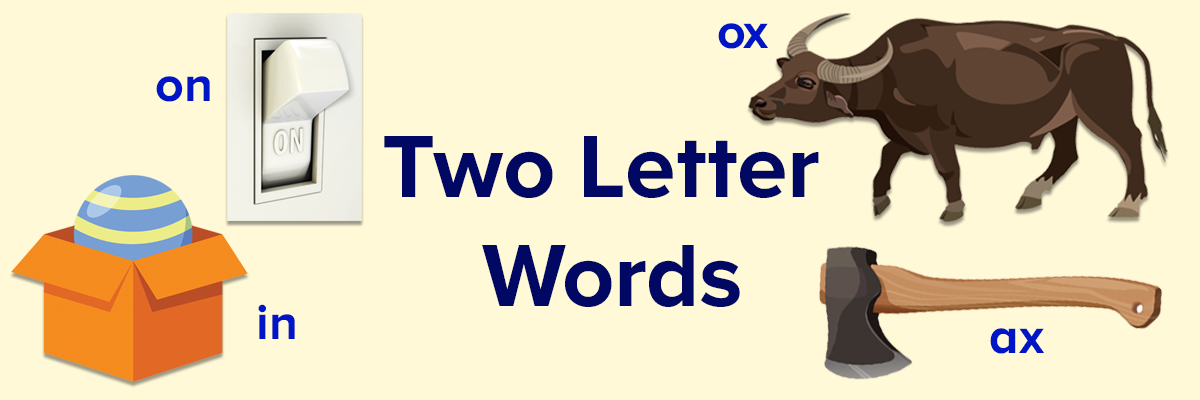
Others that you might find helpful include “as,” “in,” “on,” “at,” “we,” and “he.” Knowing these words allows learners to create simple sentences fast. In the context of SEO, common examples and practical usage cover more ground as far as relevance goes, an effort that has a great chance of being rewarded by Google’s most recent updates. This is critical for articles focused on both learners and language lovers.
Rules for Using Two‑Letter Words
Two‑letter words are easy, but they have patterns of use. Prepositions (in, on, at) bond nouns to contexts. Pronouns (such as it, we, and he) take the place of nouns to prevent repetition. An article (like an) precedes nouns to mark indefiniteness. Verbs (such as do “ and “ be) describe actions or states. Its correct usage relies on grammatical context, not on word length.
Google’s helpful content update rewards these leanings toward clarity and utility: not just listing but prescribing rules that are actionable, helping add value to your writing. Writers should never keyword-stuff (“two-letter words list”), just try to incorporate these into the explanations.
Common Mistakes and How to Avoid Them
Mistakes include the usual confusion of meaning for usage. For instance, “in” instead of “on” (“in the table” rather than “on the table”). Another problem is name-based overdependence on abbreviations that appear to be two‑letter words while behaving like none (e.g., “OK” when used as an interjection, versus “ok” when used as a word). To avoid errors:
- Know the part of speech
- Look out for examples in excellent language resources
- Rephrase the sentence for better context
“Google’s new Update is warning about overly generic content; helping readers with clear and actionable advice will help them stay engaged with your article and fulfill the search intention.”
Two‑Letter Words in Word Games and Tests
In word games like Scrabble, two‑letter words are golden, they allow players to build on existing words and rack up the points. Official word lists accept many rare two‑letter words, such as “qi” and “za,” so mastering them adds to strategy. Understanding these words in standardized tests (such as TOEFL, IELTS) contributes to reading comprehension and writing accuracy. Google’s ranking systems now reward comprehensive coverage of topic facets and articles that include usage in games, tests, and genuine communication, meet wider user intent and boost page relevance.
FAQs
Are two‑letter words important?
Yes they’re essential for forming clear, natural sentences and are widely used in English communication.
Do two‑letter words always have meaning?
Yes, every valid two‑letter word in English has a defined function, like prepositions or pronouns.
Are all two‑letter words valid in word games?
Not all official word game dictionaries have specific entries that must be learned.
Can beginners easily learn two‑letter words?
Absolutely! They’re among the first vocabulary elements taught to English learners.
Conclusion
Two‑letter words are small, but big in strong English communication. From casual conversation and academic writing to specialized environments such as word games, these little words help bind ideas together, convey relationships and express meaning in concise ways. Because search engines such as Google increasingly reward content that is engaging, clear and useful, online content with a good explanation of not just the what but also how two letter words, in this case, makes educational articles more likely to get a look in.
By learning building blocks through examples, rules of usage, and common errors to avoid, the writers and learners can increase fluency and their confidence. Whether you are an ESL student, a writer, or simply curious about the quirks of language, knowing two‑letter words provides you with an advantage in clear communication and strong writing.
Read More: 15000 in Words: How to Write Fifteen Thousand Correctly