Articles in English: A, An, The Rules With Examples
The words a, an and the are some of the smallest words in English, but they are also among the most important.
Consider these sentences:
I saw a dog.
I saw the dog.
Dogs are friendly.
All three sentences are grammatically correct, but they do not mean exactly the same thing.
In the first sentence, “a dog” means one dog that has not been identified. In the second, “the dog” refers to a particular dog. In the third sentence, no article is needed because we are talking about dogs in general.
Understanding articles in English helps you speak and write more accurately. In this lesson, you will learn when to use a, an, the and no article, along with simple rules, examples, common mistakes and practice questions.
For more lessons like this, explore the Eng Only Eng Grammar section.
What Are Articles in English?
Articles are small words used before nouns.
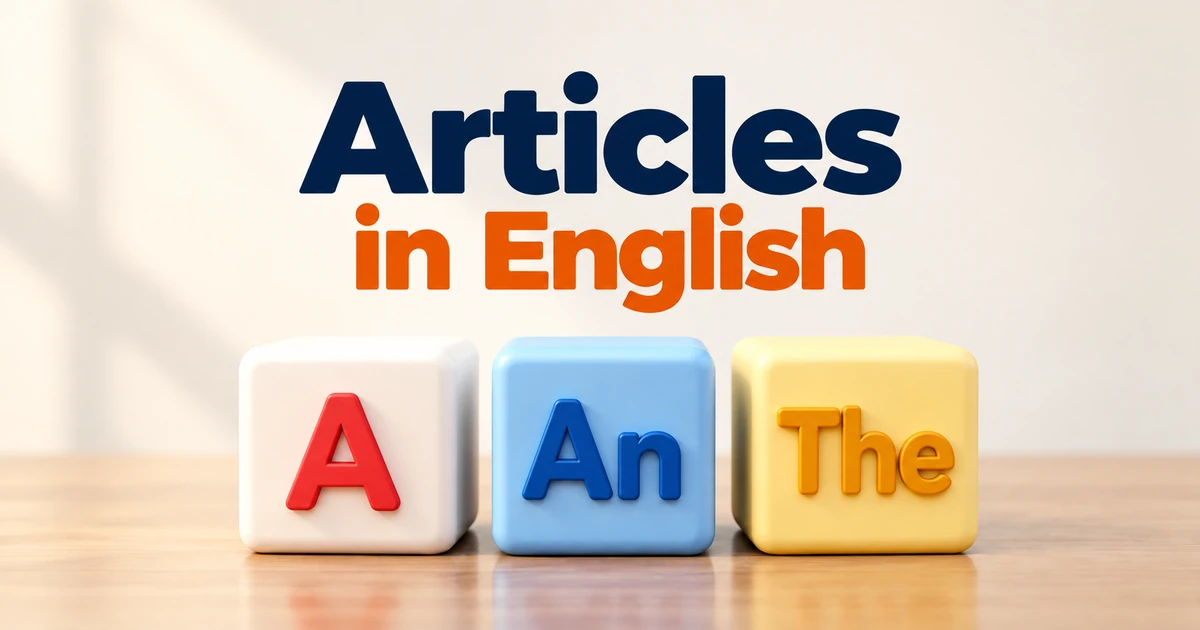
English has three articles:
A
An
The
“A” and “an” are called indefinite articles.
“The” is called the definite article.
English also uses what is sometimes called the zero article, which simply means that no article is used.
Compare:
I need a pen.
I need an umbrella.
Please close the door.
Books are useful.
Each sentence uses a different article pattern.
A, An and The at a Glance
| Article | Main Use | Example |
|---|---|---|
| a | one non specific thing before a consonant sound | a book |
| an | one non specific thing before a vowel sound | an apple |
| the | a particular or known thing | the book on the table |
| no article | things in general, many names and some uncountable nouns | Books are useful. |
The easiest way to choose an article is to ask:
Is the noun singular and countable?
Is it specific or already known?
Am I talking about something in general?
When to Use A
Use a before a singular countable noun when the next word begins with a consonant sound.
Examples:
a student
a book
a car
a teacher
a problem
We often use “a” when mentioning something for the first time.
Example:
I saw a boy outside the school.
We do not know which boy yet, so “a” is appropriate.
We also use “a” when talking about someone’s profession.
Examples:
Riya is a teacher.
My brother is a doctor.
Rahul wants to become a pilot.
A Depends on Sound, Not Only Spelling
This rule is important.
Use “a” before a consonant sound even if the written word starts with a vowel letter.
Examples:
a university
a European country
a useful book
“University” begins with the letter “u”, but its first sound is similar to “you”. That is a consonant sound, so we say “a university”.
When to Use An
Use an before a singular countable noun when the next word begins with a vowel sound.
Examples:
an apple
an egg
an idea
an orange
an umbrella
Again, sound is more important than the first written letter.
For example:
an hour
an honest person
The “h” is silent in these words, so they begin with a vowel sound when spoken.
Compare:
a house
an hour
The letter is the same, but the sound is different.
You can also see this sound based rule explained in the British Council lesson on a, an and the. British Council also notes that singular countable nouns normally need an article or another determiner. LearnEnglish – British Council
When to Use The
Use the when talking about a particular person, place or thing that the listener or reader can identify.
Example:
Please close the door.
This normally means a particular door that both people understand from the situation.
Use The After Something Has Already Been Mentioned
Example:
I saw a dog in the street.
The dog was very friendly.
The first time, we use “a dog” because it is new information.
The second time, we use “the dog” because we now know which dog we mean.
Use The for Something Unique
Examples:
the sun
the moon
the Earth
We normally use “the” because these refer to unique things in the context.
Use The With Specific Information
Compare:
Students are waiting outside.
The students in Class 8 are waiting outside.
The first sentence talks about students generally.
The second identifies a particular group, so “the” is appropriate.
When No Article Is Needed
Sometimes we do not use a, an or the.
This is often called the zero article.
General Plural Nouns
When talking about plural things in general, no article is normally needed.
Examples:
Books are useful.
Teachers help students.
Dogs need exercise.
Compare:
Dogs are friendly.
The dogs outside my house are friendly.
The first sentence means dogs generally.
The second refers to particular dogs.
General Uncountable Nouns
We also normally use no article with uncountable nouns when speaking generally.
Examples:
Water is important.
Milk contains nutrients.
Information is useful.
Education can change lives.
However, “the” may be used when the uncountable noun becomes specific.
Example:
Water is essential.
The water in this bottle is cold.
A and An With Countable Nouns
A and an are used only with singular countable nouns.
Correct:
a chair
an orange
a student
Incorrect:
a chairs
an information
a water
Words such as information, advice, furniture and water are normally uncountable in their general meanings.
Instead of:
an advice
say:
some advice
or:
a piece of advice
Understanding nouns and sentence structure can make article rules easier. Our lesson on Subject and Predicate Examples gives additional practice with how nouns and other sentence parts work together.
Common Uses of A and An
Use a or an when talking about one member of a group.
Example:
An elephant is a large animal.
Use a or an with professions.
She is an engineer.
He is a teacher.
Use a or an with certain expressions of quantity.
a hundred
a thousand
a few
a little
Use them when something is mentioned for the first time.
I bought a notebook yesterday.
Common Uses of The
Use “the” with something already known.
Where is the notebook I gave you?
Use it when context makes the noun clear.
Please turn off the light.
Use it with superlatives.
She is the tallest student in the class.
This is the best answer.
Use it with ordinal numbers in many ordinary situations.
the first chapter
the second lesson
the third question
Use it with some geographical names.
the Indian Ocean
the Himalayas
the United States
But many country and city names normally take no article.
India
Pakistan
Delhi
London
Common Mistakes English Learners Make
Mistake 1: Using A Before Every Vowel Letter
Incorrect:
an university
Correct:
a university
Remember, use the sound rather than simply looking at the first letter.
Mistake 2: Forgetting the Article Before a Profession
Incorrect:
She is teacher.
Correct:
She is a teacher.
Mistake 3: Using The When Talking Generally
Incorrect:
The books are useful for learning.
This sentence suggests particular books.
If you mean books in general:
Books are useful for learning.
Mistake 4: Using A or An With Uncountable Nouns
Incorrect:
an information
Correct:
some information
Incorrect:
an advice
Correct:
some advice
Mistake 5: Forgetting The After First Mention
Less natural:
I bought a book. A book was expensive.
Better:
I bought a book. The book was expensive.
The second sentence refers to the same book.
A Simple Three Step Method
When you are unsure which article to use, follow this method.
First, ask whether the noun is singular and countable.
If yes, it normally needs a, an, the or another determiner.
Second, ask whether the noun is specific or already known.
If yes, “the” may be needed.
Third, if the noun is singular and not specific, choose between a and an according to the first sound of the following word.
Example:
I need ___ umbrella.
“Umbrella” is singular and countable.
It is not specific.
It begins with a vowel sound.
Answer:
I need an umbrella.
Practice Exercise
Choose a, an, the or no article.
- She is ___ doctor.
- I ate ___ apple after lunch.
- ___ sun is shining brightly.
- Rahul wants to buy ___ new laptop.
- We waited for ___ hour.
- ___ books can help you improve your vocabulary.
- Please open ___ window next to you.
- He studies at ___ university in Delhi.
- She gave me ___ useful idea.
- ___ water in this glass is cold.
Answers
- a
- an
- the
- a
- an
- no article
- the
- a
- a
- the
Frequently Asked Questions
What are articles in English?
Articles are words used before nouns. The main English articles are a, an and the.
What are the two types of articles?
A and an are indefinite articles. The is the definite article.
When should I use a?
Use a before a singular countable noun beginning with a consonant sound, such as “a book” or “a university”.
When should I use an?
Use an before a singular countable noun beginning with a vowel sound, such as “an apple” or “an hour”.
When should I use the?
Use the when referring to a specific, known or identifiable person or thing.
Why do we say “a university” but “an hour”?
Article choice depends on pronunciation. “University” begins with a consonant “you” sound, while the “h” in “hour” is silent.
Can a sentence have no article?
Yes. Plural and uncountable nouns often appear without an article when referring to things in general.
Conclusion
Articles in English become much easier once you understand the basic idea behind them.
Use a before a consonant sound when talking about one non specific thing.
Use an before a vowel sound when talking about one non specific thing.
Use the when talking about something specific or already known.
Use no article when talking generally about many plural or uncountable nouns.
Do not try to memorise every possible sentence. Learn the core rules, notice articles while reading and practise them in your own sentences.
For more simple English grammar and vocabulary lessons, visit Eng Only Eng.