
Collocations: 50 Common Examples With Meanings and Sentences
Some English words naturally belong together.
We say “make a decision”, not “do a decision”. We say “heavy rain”, not “strong rain”. We also say “take a break”, “pay attention” and “catch a bus”.
These natural word combinations are called collocations.
Learning collocations is important because correct grammar alone does not always make English sound natural. Cambridge explains collocation as the way words regularly occur together or form established relationships. For example, “heavy rain” is natural English, while “thick rain” is not.
In this lesson, you will learn common types of collocations, 50 useful examples, common mistakes and a short exercise with answers.
For more vocabulary lessons, explore the Eng Only Eng Vocabulary section.
What Is a Collocation?
A collocation is a combination of two or more words that are commonly used together.
For example:
make a mistake
strong coffee
heavy traffic
deeply worried
take an exam
The individual words may be grammatically correct in other combinations, but some combinations simply sound more natural.
For example:
Correct: heavy rain
Unnatural: powerful rain
Correct: make a mistake
Incorrect: do a mistake
The British Council notes that using the correct collocation helps English sound more natural and precise.
Why Are Collocations Important?
Learning collocations helps you use vocabulary as complete patterns instead of learning isolated words.
If you learn only the word “decision”, you may not know whether to use “make”, “do” or “take” before it.
If you learn the complete collocation “make a decision”, you can use it correctly straight away.
Collocations can improve your:
Speaking
Writing
Vocabulary
Reading comprehension
Exam performance
Natural sentence formation
The British Council also recommends noticing word combinations in real texts and recording useful collocations together rather than memorising individual words only.
Common Types of Collocations
English collocations appear in several patterns.
Verb + Noun
make a decision
do homework
catch a bus
pay attention
Adjective + Noun
heavy rain
strong coffee
high temperature
great opportunity
Adverb + Adjective
deeply worried
highly successful
completely different
perfectly clear
Noun + Noun
traffic jam
school bus
football match
language skills
Verb + Adverb
speak softly
work hard
smile politely
apologise sincerely
Knowing these patterns makes it easier to recognise new collocations while reading.
50 Common Collocations With Meanings and Examples
| Collocation | Meaning | Example Sentence |
|---|---|---|
| make a decision | choose something | We need to make a decision today. |
| make a mistake | do something incorrectly | Everyone can make a mistake. |
| make progress | improve | Priya is making good progress in English. |
| make an effort | try hard | Make an effort to speak English every day. |
| make friends | form friendships | Rohan made new friends at college. |
| do homework | complete school work | I do my homework after dinner. |
| do exercise | perform physical activity | We should do regular exercise. |
| do your best | try as hard as possible | Just do your best in the exam. |
| take a break | stop briefly to rest | Let us take a break after this lesson. |
| take notes | write important information | Students should take notes during class. |
| take an exam | sit for an examination | I will take an English exam next month. |
| take responsibility | accept responsibility | He took responsibility for the mistake. |
| pay attention | concentrate | Please pay attention to the teacher. |
| pay a visit | visit someone or somewhere | We paid a visit to the museum. |
| catch a bus | get on a bus | I catch a bus to school every morning. |
| catch a cold | become ill with a cold | She caught a cold during winter. |
| keep a promise | do what you promised | Good friends keep their promises. |
| keep in touch | continue communicating | We still keep in touch after school. |
| have breakfast | eat the morning meal | I have breakfast at seven. |
| have a problem | experience difficulty | I have a problem with this question. |
| have fun | enjoy yourself | The children had fun at the school event. |
| give advice | advise someone | My teacher gave me useful advice. |
| give permission | allow something | The teacher gave us permission to leave. |
| ask a question | request information | You can ask a question at any time. |
| tell the truth | say what is true | Always tell the truth. |
| heavy rain | a lot of rain | Heavy rain continued all night. |
| heavy traffic | many vehicles causing delay | We were late because of heavy traffic. |
| strong coffee | coffee with a powerful flavour | My father prefers strong coffee. |
| strong argument | convincing argument | She presented a strong argument. |
| high temperature | elevated temperature | Delhi recorded a high temperature today. |
| high quality | very good quality | This dictionary is of high quality. |
| great opportunity | very good chance | This course is a great opportunity to learn. |
| great success | major success | The school event was a great success. |
| close friend | very good friend | Rahul is one of my close friends. |
| serious problem | important problem | Pollution is a serious problem. |
| hard work | strong effort | Success usually requires hard work. |
| bright future | promising future | Good education can lead to a bright future. |
| fast learner | someone who learns quickly | Neha is a fast learner. |
| deeply worried | very worried | His parents were deeply worried. |
| highly successful | very successful | The programme became highly successful. |
| completely different | totally different | The two answers are completely different. |
| perfectly clear | very easy to understand | The teacher’s explanation was perfectly clear. |
| strongly recommend | recommend with confidence | I strongly recommend this English dictionary. |
| fully aware | completely aware | She is fully aware of the rules. |
| speak English | communicate in English | Try to speak English every day. |
| speak softly | speak quietly | Please speak softly in the library. |
| work hard | make a strong effort | Students who work hard usually improve. |
| apologise sincerely | give a genuine apology | He apologised sincerely for his behaviour. |
| save time | use less time | This method can save time. |
| waste time | use time badly | Do not waste time before your exam. |
Strong and Weak Collocations
Not every collocation has the same level of restriction.
Some combinations are very fixed.
For example:
utter disappointment
blissfully unaware
commit a crime
Other words can combine naturally with many different words.
For example:
big house
big problem
big difference
big opportunity
Cambridge describes these as strong and weak collocations. Strong collocations allow fewer natural alternatives, while weak collocations can combine with many different words.
You do not need to memorise these labels for everyday speaking, but understanding the idea helps explain why some word combinations feel more fixed than others.
Common Collocation Mistakes
One of the most common problems is choosing a word because it has a similar meaning.
Do a Mistake
Incorrect:
I did a mistake.
Correct:
I made a mistake.
Make Homework
Incorrect:
I made my homework.
Correct:
I did my homework.
Strong Rain
Unnatural:
There was strong rain yesterday.
Natural:
There was heavy rain yesterday.
Big Traffic
Incorrect:
There was big traffic.
Correct:
There was heavy traffic.
Give an Exam
In some varieties of Indian English, you may hear “give an exam” when referring to a student taking an examination.
For internationally understood standard English, a student normally takes or sits an exam, while a teacher or examining body may give, set or administer the exam.
This is a useful distinction for students preparing for interviews, IELTS or formal writing.
Collocations vs Idioms
A collocation is a natural combination of words whose meaning is usually understandable.
Example:
heavy rain
The meanings of “heavy” and “rain” still help you understand the expression.
An idiom often has a figurative meaning that cannot be understood simply from its individual words.
Example:
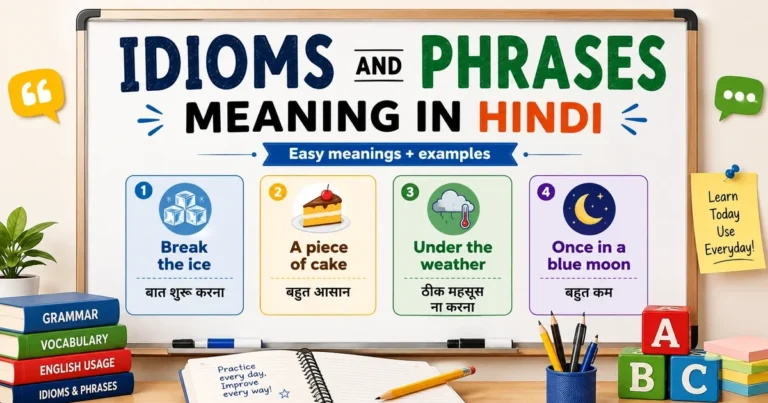
break the ice
This means to make people feel more comfortable in a social situation. It does not normally mean breaking real ice.
So remember:
Collocation = words that naturally go together
Idiom = expression with a special or figurative meaning
Collocations vs Phrasal Verbs
Phrasal verbs combine a verb with a particle and create a particular meaning.
Examples:
give up
look after
turn off
find out
Collocations are a much broader group of natural word combinations.
Examples:
make progress
strong coffee
heavy rain
pay attention
A phrasal verb may itself appear inside a larger collocation, but the two terms describe different language patterns.
How to Learn Collocations Easily
The best approach is to learn the complete combination.
Do not write:
decision = choice
Instead, record:
make a decision
difficult decision
important decision
final decision
This teaches you how the word actually behaves in English.
Your vocabulary notebook can also group collocations around one important word.
For example:
make a mistake
correct a mistake
common mistake
serious mistake
simple mistake
You can build vocabulary further with our lesson on Prefix and Suffix Examples.
Quick Practice Exercise
Choose the correct word.
- Please ______ attention to the instructions.
a. make
b. pay
- I always ______ my homework after school.
a. do
b. make
- We had ______ rain yesterday.
a. heavy
b. powerful
- You need to ______ a decision soon.
a. make
b. do
- Rahul ______ a bus to college.
a. catches
b. takes up
- She is ______ worried about her exam.
a. deeply
b. heavily
- Please ______ your best.
a. do
b. make
- We should ______ in touch after the course.
a. keep
b. make
Answers
- pay
- do
- heavy
- make
- catches
- deeply
- do
- keep
Frequently Asked Questions
What are collocations?
Collocations are words that commonly and naturally occur together, such as “make a decision”, “heavy rain” and “pay attention”.
What are five examples of collocations?
Five common examples are make a mistake, do homework, take a break, strong coffee and heavy traffic.
Why are collocations important?
They help your English sound more natural and improve vocabulary, speaking and writing.
Is “heavy rain” a collocation?
Yes. “Heavy rain” is a standard adjective + noun collocation.
Is “make a decision” a collocation?
Yes. “Make a decision” is a common verb + noun collocation.
What is the difference between a collocation and an idiom?
A collocation is a natural word combination whose meaning is usually clear. An idiom often has a figurative meaning that is different from its literal words.
How can I improve my collocations?
Read regularly, notice words that frequently appear together, use a reliable learner’s dictionary and record complete word combinations instead of individual vocabulary words.
Conclusion
Collocations are one of the keys to natural English.
Knowing the words “decision”, “attention” and “rain” is useful, but knowing make a decision, pay attention and heavy rain makes those words much easier to use correctly.
Start with everyday collocations rather than trying to memorise hundreds at once. Learn each combination in a sentence, notice it when reading and use it in your own speaking and writing.
With regular practice, these word combinations will begin to feel natural.
For more learner-friendly vocabulary and grammar lessons, visit Eng Only Eng.
For a detailed authoritative explanation, see Cambridge Dictionary’s guide to collocations.