Phrasal Verbs: 50 Common Examples With Meanings and Sentences
Phrasal verbs are everywhere in everyday English.
You may hear someone say “wake up”, “turn off the light”, “look after the children”, or “give up”. Each expression contains a verb combined with another small word, but together they often create a new meaning.
For example:
Give = to provide something
Give up = to stop trying or stop doing something
This is why phrasal verbs can be confusing for English learners. You may understand every individual word but still not understand the complete expression.
In this lesson, you will learn 50 common phrasal verbs with simple meanings, natural examples, important grammar rules and a short practice exercise.
You can also explore more English word lessons in the Eng Only Eng Vocabulary section.
What Is a Phrasal Verb?
A phrasal verb is a verb combined with one or two particles, usually an adverb or preposition.
Together, the words act as one verb.
For example:
look + after = look after
“Look” normally means to direct your eyes towards something.
But:
look after = take care of
Example:
Priya looks after her younger brother after school.
Another example:
turn + down = turn down
turn down = refuse or reject
Example:
He turned down the job offer.
The British Council explains that phrasal verbs are very common in English, especially in informal communication, and that the particle can change the meaning of the original verb.
50 Common Phrasal Verbs With Meanings and Examples
| Phrasal Verb | Meaning | Example Sentence |
|---|---|---|
| break down | stop working | Our school bus broke down this morning. |
| bring up | mention a topic | She brought up an important question. |
| call back | return a phone call | I will call you back after class. |
| call off | cancel | They called off the meeting. |
| carry on | continue | Please carry on with your work. |
| carry out | perform or complete | The students carried out the experiment. |
| come across | find by chance | I came across an interesting English book. |
| come back | return | He came back from school at four. |
| come up with | produce an idea | We need to come up with a better solution. |
| cut down on | reduce | I am trying to cut down on screen time. |
| figure out | understand or solve | I finally figured out the answer. |
| fill in | complete a form | Please fill in this application form. |
| find out | discover | We need to find out what happened. |
| get along | have a good relationship | The two classmates get along well. |
| get back | return | What time did you get back home? |
| get over | recover | She quickly got over her disappointment. |
| get up | leave your bed | I get up at six every morning. |
| give back | return something | Please give my notebook back. |
| give up | stop trying | Do not give up when English seems difficult. |
| go on | continue or happen | Please go on with your explanation. |
| grow up | become an adult | Rahul wants to become a doctor when he grows up. |
| hand in | submit | Please hand in your homework tomorrow. |
| hold on | wait | Hold on for a moment, please. |
| keep on | continue | Keep on practising your pronunciation. |
| look after | take care of | She looks after her younger sister. |
| look for | try to find | I am looking for my dictionary. |
| look into | investigate | The teacher will look into the problem. |
| look up | search for information | Look up the word in a dictionary. |
| pick up | collect | My father will pick me up after school. |
| point out | draw attention to | The teacher pointed out my spelling mistake. |
| put away | return to its proper place | Put your books away after studying. |
| put off | postpone | They put off the test until Monday. |
| put on | wear | Put on your school uniform. |
| run out of | have none left | We have run out of paper. |
| set up | arrange or establish | They set up a new study group. |
| sit down | take a seat | Please sit down quietly. |
| take off | remove | Take off your shoes before entering. |
| take over | gain control | A new manager took over the department. |
| throw away | discard | Do not throw away useful notes. |
| try on | wear to check size | She tried on the new uniform. |
| turn down | reject | He turned down the invitation. |
| turn off | stop a device | Turn off the computer before leaving. |
| turn on | start a device | Please turn on the projector. |
| wake up | stop sleeping | I wake up early on school days. |
| work out | solve | Can you work out this maths problem? |
| write down | record in writing | Write down the new vocabulary words. |
| check out | examine | Check out this useful English resource. |
| move on | continue to the next thing | Let us move on to the next question. |
| pick out | choose | Can you pick out the correct answer? |
| speak up | speak more loudly | Please speak up so everyone can hear you. |
Separable and Inseparable Phrasal Verbs
One important rule is that some phrasal verbs can be separated, while others cannot.
Separable Phrasal Verbs
With some phrasal verbs, an object can go between the verb and particle.
For example:
Turn off the light.
Turn the light off.
Both sentences are correct.
But when the object is a pronoun such as “it”, the pronoun normally goes between the two parts.
Correct:
Turn it off.
Incorrect:
Turn off it.
Another example:
Pick up the books.
Pick the books up.
Pick them up.
The British Council also highlights this pronoun rule when explaining separable phrasal verbs.
Inseparable Phrasal Verbs
Other phrasal verbs must stay together.
For example:
Look after the child.
Correct:
Look after her.
Incorrect:
Look her after.
“Come across”, “get over” and “look into” are other common examples of inseparable phrasal verbs.
One Phrasal Verb Can Have More Than One Meaning
Another reason phrasal verbs can be challenging is that the same expression may have different meanings.
Consider “pick up”.
It can mean to collect someone:
My father will pick me up from school.
It can also mean to learn something naturally:
She picked up some new English words while reading.
Similarly, “break down” can mean that a machine stops working:
Our car broke down.
It can also be used when something is divided into smaller parts:
Let us break the problem down into three steps.
Always learn phrasal verbs through complete sentences, not as isolated expressions.
Common Phrasal Verbs for Students
Students can start with phrasal verbs that appear naturally in school and everyday routines.
Get up:
I get up at 6:30 every morning.
Write down:
Write down the answer in your notebook.
Look up:
Look up unfamiliar words in a dictionary.
Hand in:
Please hand in your assignment before Friday.
Find out:
Find out the meaning of this word.
Go over:
Let us go over the lesson once more.
Keep up:
Keep up the good work.
Work out:
Try to work out the answer yourself.
These are easier to remember because you can connect them with situations you experience regularly.
Phrasal Verbs and Formal English
Phrasal verbs are especially common in everyday spoken English.
Sometimes a single-word verb sounds more formal.
For example:
find out = discover
put off = postpone
look into = investigate
come up with = develop or propose
However, this does not mean phrasal verbs are always incorrect in formal English. Expressions such as “carry out”, “point out” and “set up” also appear in professional and academic contexts.
The British Council notes that phrasal verbs are particularly common in informal English, although many are used more widely.
Common Mistakes to Avoid
A common mistake is translating each part separately.
For example:
“Give up” does not normally mean “give something upwards”.
It means to stop doing something or stop trying.
Another mistake is separating an inseparable phrasal verb.
Incorrect:
I look my younger brother after.
Correct:
I look after my younger brother.
Learners also sometimes place pronouns incorrectly.
Incorrect:
Turn off it.
Correct:
Turn it off.
Finally, do not assume that every phrasal verb has only one meaning. Always check the context.
How to Learn Phrasal Verbs Faster
Do not try to memorise hundreds of phrasal verbs in alphabetical order.
Learn them in situations.
For example, for studying:
write down
look up
go over
hand in
find out
For daily routines:
wake up
get up
put on
take off
go out
Learning a phrasal verb inside a natural sentence is usually much easier than memorising only its definition.
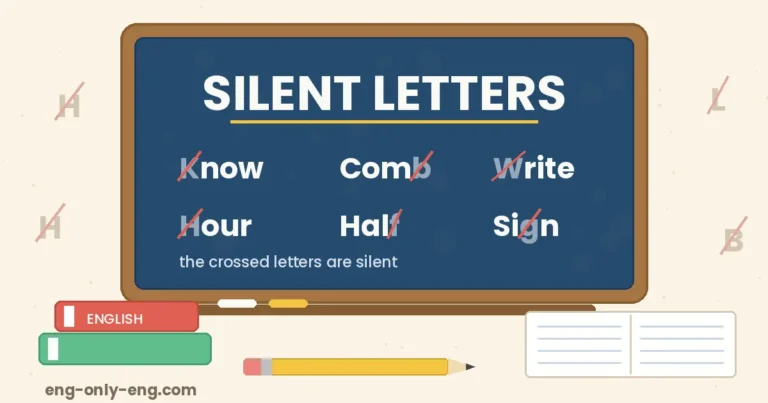
You can also strengthen your spelling and vocabulary through the Eng Only Eng lesson on Silent Letters Words in English.
Practice Exercise
Choose the correct phrasal verb.
- Please ________ your homework tomorrow.
a. hand in
b. break down
- I need to ________ this unfamiliar word.
a. look up
b. give up
- The meeting was ________ because the teacher was absent.
a. called off
b. picked up
- Please ________ the lights before leaving.
a. turn off
b. grow up
- Never ________ when learning something difficult.
a. give up
b. put on
- We have ________ paper.
a. run out of
b. looked after
- My father will ________ me from school.
a. pick up
b. throw away
- Please ________ your answer.
a. write down
b. take over
Answers
- hand in
- look up
- called off
- turn off
- give up
- run out of
- pick up
- write down
Frequently Asked Questions
What are phrasal verbs?
Phrasal verbs are combinations of a verb and one or more particles that work together as a single verb.
What are five common phrasal verbs?
Five common examples are get up, look after, give up, turn off and find out.
What is an example of a separable phrasal verb?
“Turn off” is separable.
You can say:
Turn off the light.
Or:
Turn the light off.
What is an example of an inseparable phrasal verb?
“Look after” is inseparable.
Correct:
She looks after him.
Not:
She looks him after.
Why are phrasal verbs difficult?
Their meanings are not always obvious from the individual words, and some phrasal verbs also have several meanings.
How can I learn phrasal verbs easily?
Learn a few at a time, group them by situation and practise them in complete sentences.
Conclusion
Phrasal verbs are an important part of natural English.
Expressions such as “get up”, “find out”, “look after”, “turn off” and “give up” appear frequently in everyday conversations, school situations and written English.
Instead of memorising huge lists, start with common phrasal verbs that you can actually use. Learn their meanings, notice whether they are separable or inseparable and write your own example sentences.
A few minutes of regular practice can make phrasal verbs much easier to understand and use confidently.
For more simple English vocabulary and grammar lessons, visit Eng Only Eng.