WH Questions with Examples: Meaning, Rules and Easy Sentence Structures
Have you ever wanted to ask something in English but stopped because you were not sure how to start the question? You are not alone. Many learners in India can answer questions well, but they hesitate when they have to ask one. The secret lies in mastering WH questions. Once you understand how these questions work, you can talk to anyone, in class, in an interview, or in daily life, with full confidence.
In this lesson, you will learn what WH questions are, the simple rules to form them, plenty of WH questions with examples and answers, the common mistakes learners make, and a short practice exercise at the end. Let us begin.
What Are WH Questions?
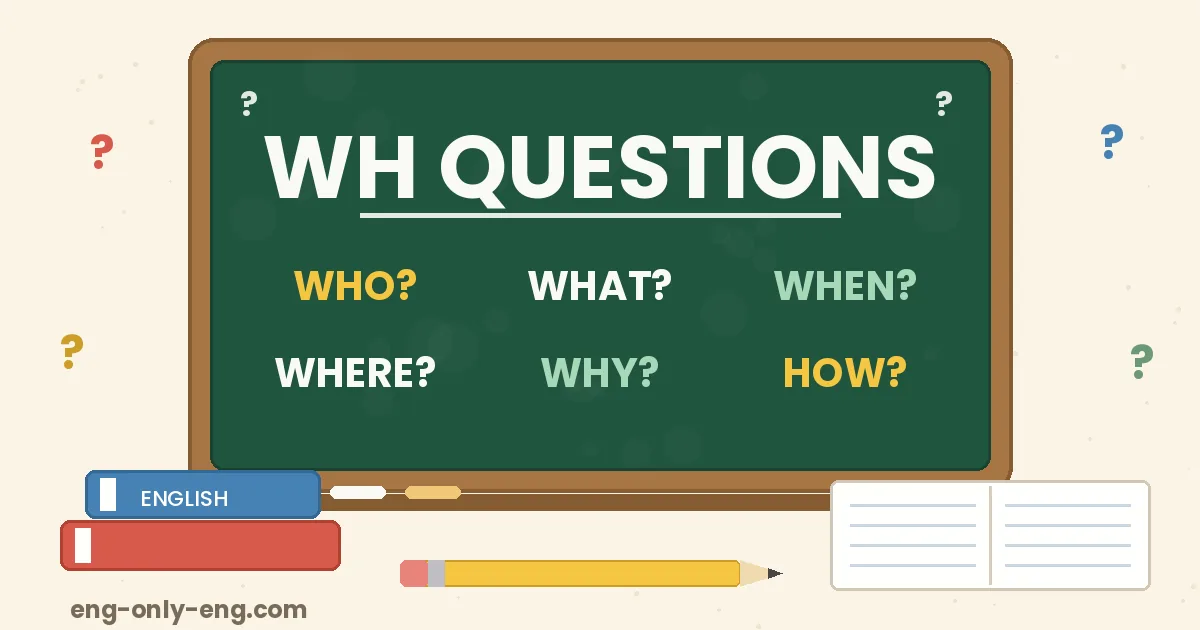
WH questions are questions that begin with a WH word such as who, what, when, where, why, which, whose, and how. We use them to ask for information, not for a yes or no answer. For example, “Where do you live?” cannot be answered with “yes” or “no”. The answer must give information, like “I live in Jaipur.”
That is why WH questions are also called open questions (questions with many possible answers). Compare these two:
- Yes/No question: “Do you like tea?” Answer: “Yes.”
- WH question: “Why do you like tea?” Answer: “Because it keeps me fresh in the morning.”
You can see the difference. WH questions open up a conversation, while yes/no questions often close it.
Note: “How” does not start with the letters WH, but grammar books still count it as a WH question word because it works in exactly the same way.
If you want a detailed list of each question word with its meaning, read our full guide on what are question words first. This lesson goes one step further and teaches you how to build complete questions with them.
The 8 WH Question Words at a Glance
| WH Word | Asks About | Example Question | Example Answer |
|---|---|---|---|
| Who | A person | Who teaches you Maths? | Sharma Sir teaches us Maths. |
| What | A thing or action | What is your name? | My name is Priya. |
| When | Time | When does the train leave? | It leaves at 6 pm. |
| Where | A place | Where is your office? | It is in Connaught Place. |
| Why | A reason | Why are you late? | Because the bus broke down. |
| Which | A choice | Which colour do you like? | I like blue. |
| Whose | Possession (ownership) | Whose bag is this? | It is Raj’s bag. |
| How | Manner or way | How do you go to college? | I go by metro. |
“How” also joins with other words to ask about quantity and degree: how much (price or amount), how many (number), how often (frequency), how long (duration), and how far (distance).
How to Form WH Questions: 3 Simple Rules
Most learners know the WH words but make mistakes in word order. These three rules solve that problem.
Rule 1: With “be” verbs (is, am, are, was, were)
Structure: WH word + be verb + subject
- Where is your school?
- Why are they upset?
- When was the exam?
There is no extra helping verb here. The “be” verb simply moves before the subject.
Rule 2: With do, does and did
When the sentence has a main action verb (eat, go, study, work), we add do, does, or did after the WH word.
Structure: WH word + do/does/did + subject + main verb (base form)
- What do you eat for breakfast?
- Where does Priya work?
- Why did Raj miss the class?
Important: after do, does, or did, the main verb always stays in its base form. We say “Where does she live?” and never “Where does she lives?” The word “does” already shows the tense, so the main verb does not change.
Rule 3: With modal verbs (can, will, should, must)
Structure: WH word + modal + subject + main verb
- What can I do for you?
- When will the results come?
- How should we prepare for the interview?
Special Case: Subject Questions (No Helping Verb Needed)
When the WH word itself is the subject of the sentence, do not add do, does, or did. Keep the normal sentence order.
- Who broke the window? (Not: Who did break the window?)
- What happened yesterday?
- Which team won the match?
Here the WH word replaces the person or thing doing the action, so no helping verb is required. The <a href=”https://dictionary.cambridge.org/us/grammar/british-grammar/questions-wh-questions”><strong>Cambridge Dictionary grammar guide on wh-questions</strong></a> explains this subject and object difference in more depth if you want extra reading.
30 WH Questions with Examples and Answers
Now let us practise with real sentences. These WH questions with examples and answers cover daily life, school, and work situations that Indian learners face every day.
Who: Questions About People
- Who is your best friend? My best friend is Aman.
- Who cooked this biryani? My mother cooked it.
- Who is calling you again and again? It is my project partner.
- Who won the quiz competition? Priya won it.
- Who will collect the tickets? Raj will collect them.
What: Questions About Things and Actions
- What is your father’s occupation? He is a bank manager.
- What did you buy from the market? I bought vegetables and fruits.
- What time does the shop open? It opens at 10 am.
- What are you studying these days? I am preparing for the SSC exam.
- What should I wear for the interview? Wear formal clothes.
When: Questions About Time
- When is your birthday? It is on 15 August.
- When did you reach home? I reached home at 9 pm.
- When will the monsoon start? It usually starts in June.
- When do banks close? They close at 4 pm.
- When can we meet? We can meet on Sunday.
Where: Questions About Places
- Where do you live? I live in Lucknow.
- Where is the nearest metro station? It is near the mall.
- Where did you complete your graduation? I completed it from Delhi University.
- Where should I submit this form? Submit it at counter number 3.
- Where are my keys? They are on the table.
Why: Questions About Reasons
- Why are you learning English? Because I want a better job.
- Why did the teacher scold Raj? Because he forgot his homework.
- Why is the road closed today? Because of the marathon.
- Why do we celebrate Republic Day? To honour our Constitution.
- Why should I read every day? Because reading improves vocabulary.
Which, Whose and How
- Which subject do you like the most? I like English the most.
- Whose mobile is ringing? It is Priya’s mobile.
- How do you come to office? I come by local train.
- How much does this shirt cost? It costs 800 rupees.
- How many students are in your class? There are 40 students.
Common Mistakes Indian Learners Make
These are the errors teachers see most often. Check whether you make any of them.
Mistake 1: Wrong word order. Learners often say “Where you are going?” The correct form is “Where are you going?” The helping verb must come before the subject.
Mistake 2: Double past tense. “Why did you went there?” is wrong. After “did”, use the base verb: “Why did you go there?”
Mistake 3: Adding “does” to subject questions. “Who does teach this class?” is incorrect. Say “Who teaches this class?” because “who” is the subject here.
Mistake 4: Forgetting the helping verb completely. “What you want?” is incomplete. The correct question is “What do you want?”
Mistake 5: Confusing “which” and “what”. Use “which” when the choices are limited (“Which of these two pens do you want?”) and “what” when the options are open (“What is your dream job?”).
WH Questions in Exams and Interviews
WH questions are everywhere in real life, so mastering them gives you a direct advantage.
In the IELTS Speaking test, Part 1 is full of WH questions such as “Where are you from?”, “What do you do?”, and “How do you spend your weekends?” Practising complete, confident answers to these questions can improve your band score.
In job interviews, questions like “Why should we hire you?” and “What are your strengths?” are standard. If you understand the structure of the question, you can plan the structure of your answer.
In school and competitive exams, comprehension passages always include WH questions, because they test whether you truly understood the passage or not.
For more easy lessons on tenses, sentence structure, and letter formats, visit our English grammar section, where new topics are added regularly.
Quick Practice Exercise
Fill in the correct WH word. Answers are given below, but try first without looking.
- ______ is the Prime Minister of India?
- ______ does the film start?
- ______ did you park the scooter?
- ______ are you crying?
- ______ pen is this, yours or Raj’s?
Answers: 1. Who 2. When 3. Where 4. Why 5. Whose
Practice tip: pick any object near you and ask five WH questions about it aloud. For example, for your phone: Who gifted it? What is its price? When did you buy it? Where was it made? Why do you like it? This two-minute habit trains your brain to form questions automatically.
Frequently Asked Questions
What are WH questions in English?
WH questions are information questions that start with who, what, when, where, why, which, whose, or how. They cannot be answered with yes or no; the answer must give details.
How many WH questions are there?
There are eight main WH question words: who, what, when, where, why, which, whose, and how. “How” is included even though it does not begin with WH.
What is the structure of a WH question?
The most common structure is WH word + helping verb + subject + main verb. For example, “Where do you live?” Subject questions like “Who called you?” do not need a helping verb.
Is “how” a WH question?
Yes. Although “how” starts with the letter H, it works exactly like the other WH words, so grammar books treat it as a WH question word.
What is the difference between WH questions and yes/no questions?
Yes/no questions begin with a helping verb (“Do you like cricket?”) and expect yes or no. WH questions begin with a question word (“Why do you like cricket?”) and expect information.
Conclusion
WH questions are the backbone of English conversation. With just eight words and three simple structures, you can ask about people, places, time, reasons, choices, and methods. Remember the golden rules: put the helping verb before the subject, keep the main verb in its base form after do, does, or did, and skip the helping verb in subject questions. Revise the WH questions with examples given above, practise the exercise daily, and soon asking questions in English will feel as natural as answering them. For more free English lessons, tools, and courses, explore Eng Only Eng and keep learning every day.