What Are Question Words? Definition, List, and Examples
The things we use to communicate clearly and with meaning. We use question words when we want information rather than just a simple “yes” or “no.” Words like these allow us to inquire about people, places, time, reasons, choices, and methods. As users usually search in the form of questions, question-based queries play a very significant role in contemporary content writing.
After releases or improvements to our updates, including the Google Search Core update, search engines reward helpful content that responds to users’ questions the way they want. Thus, the students are not the only ones who study these grammar tensions (they care about what question words there are), but so do bloggers and writers wanting to make this content search-friendly. Here is a truly lively take on what are the pure definition, usage, structure and examples of question words.
What Are Question Words?
They are also called interrogative words and information questions. They are known as WH-words, because most of them start with “wh” (who, what, where, when and why). These words help us look for particular answers instead of yes or no. So, instead of asking “Did you go out?” you could say, “Where the hell have you been? which gives clearer information.
Tip: Words that this question is one of the useful words in English grammar because question words can enrich our communication. Their use, in conversations, interviews, classrooms and writing tasks is very common. This fills a gap that is very much needed for both beginner and advanced learners, covering topics such as sentence structure, clarity, and general language improvement.
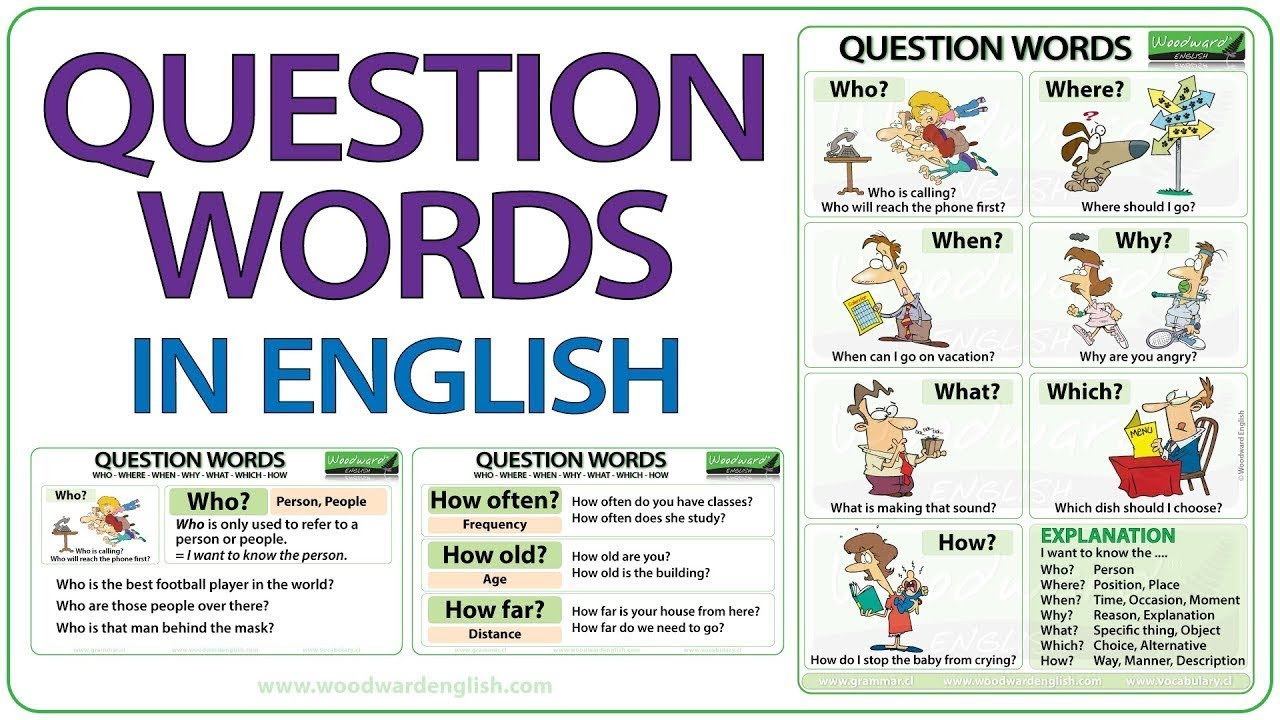
List of Common Question Words
- Who – asks about a person
- Whom – object form of who
- Whose – asks about possession
- What – asks about things or information
- Which – asks about choice
- When – asks about time
- Where – asks about place
- Why – asks about the reason
- How – asks about method, condition, or manner
These are the main question words used in English. Each one serves a specific purpose and helps form meaningful questions in daily conversations and formal writing.
Types of Question Words with Clear Examples
The first aspect of question words can be categorized by the type of information being requested. Some of the words we use to ask questions are for asking about people: “who,” “whom,” and “whose.” For instance, “Who is your teacher? asks about a person. What and “which,” other question words, are used to ask about things or options. For example, “What subject do you like?” asks about preference. Words of this kind when, where, for example, inquire about time and place. “Why” is about reasons, and “how” is about methods or circumstances. These make it easy to form the right questions, grammatically and accurately, in spoken as well as written English.
Rules for Using Question Words Correctly
There are basic grammar simple rules to use the question works properly. Let’s take a look at the structure of ordinary questions in English: Question word + auxiliary verb + subject + main verb. In terr, “Where do you live?” and “Why is she upset?” follow this structure. However, if only the question word is the subject, no auxiliary verb is necessary.
Like, “Who broke the glass? is correct. Every question must also end with a question mark. Good order of all words and punctuation creates a clear distinction in writing, making it professional. It is imperative for good grammar to be present in academic work, professional communication, and writing for SEO, which rely heavily on readability.
Importance of Question Words in Communication and Writing
In English, the use of wh- questions plays an important role in effective communication as they promote extended answering. That assists humans in arousing curiosity, solving problems, doing research and seeing the situation clearly. In classrooms, teachers use question words to gauge students’ comprehension. They help obtain full information in journalism and interviews. Because most searches done digitally are in the form of questions; therefore, question words are highly valuable in digital content writing.
Headings and answering specific questions within the content in which that question is asked lead to better user experience and engagement. Helpful content is being favored by modern search algorithms that target user intent. Thus, question words are not only important for writing well in grammar but also for developing the capacity of good blogging, articles, and academic assignments.
Common Mistakes and How to Avoid Them
When we talk about question words, many learners make the same small mistakes: One mistake is the wrong word order, such as saying “Where are you going?” rather than “Where are you going?” Another huge one is omitting auxiliary verbs in questions when they are needed. Some also mix up “who” and “whom” in formal writing.
Other frequent grammar and punctuation mistakes involve the omission of question marks at the end of questions. One way to prevent these mistakes is to practice the formation of questions every day and review basic grammar rules now and then. Reading lots of English and noticing how sentences are structured also helps, since this means you’ll grow more comfortable with things like question words.
FAQs
What are question words?
Question words are words used to ask for specific information instead of yes or no answers.
Why are question words important?
They make communication clear, detailed, and meaningful in both speaking and writing.
How many main question words are there?
There are nine main question words: who, whom, whose, what, which, when, where, why, and how.
Is “how” a question word even without “wh”?
Yes, “how” is a question word even though it does not start with “wh.”
Conclusion
Question words are a major part of English grammar, the ones that help us to inquire properly! They enable us to obtain insights into who, where, when, why, how, and which. Grasping their definitions, types, rules and examples can help learners conquer their skills in communication.
The accuracy of question words improves clarity when interacting verbally, in academic writing, and within a professional environment. This is much more powerful and attention-grabbing in today’s digital age, when user-centric content is at the top. Whether you’re a student, teacher, blogger or professional writer, question words are an essential aspect of grammar that will leave your writing far more confident with every word that’ll create precise and strong writing.
Read More: Understanding Two-Letter Words: Definitions and Usage